


VTech Sort and Discover Activity Wagon for Toddlers, Pink: A Rolling Activity Center for Little Explorers
Toys that grow with a child tend to earn their place in the playroom, and the VTech Sort and Discover Activity Wagon for Toddlers in Pink is designed around exactly that idea. It combines a multi-sided activity center with a small wagon that can be pushed or pulled, giving toddlers something to explore before they can walk and something to haul around once they can. Intended for ages 12 to 36 months, it targets a stage when curiosity is high and little hands are eager to flip, spin, slide, and sort whatever they can reach.
Rather than asking parents to buy separate toys for floor play and on-the-go play, this wagon attempts to cover both. The activities live on the outside, while the inside offers open storage for toys, snacks, and other small items. That dual-purpose approach is the core of what this product is about.
Design & Build Quality
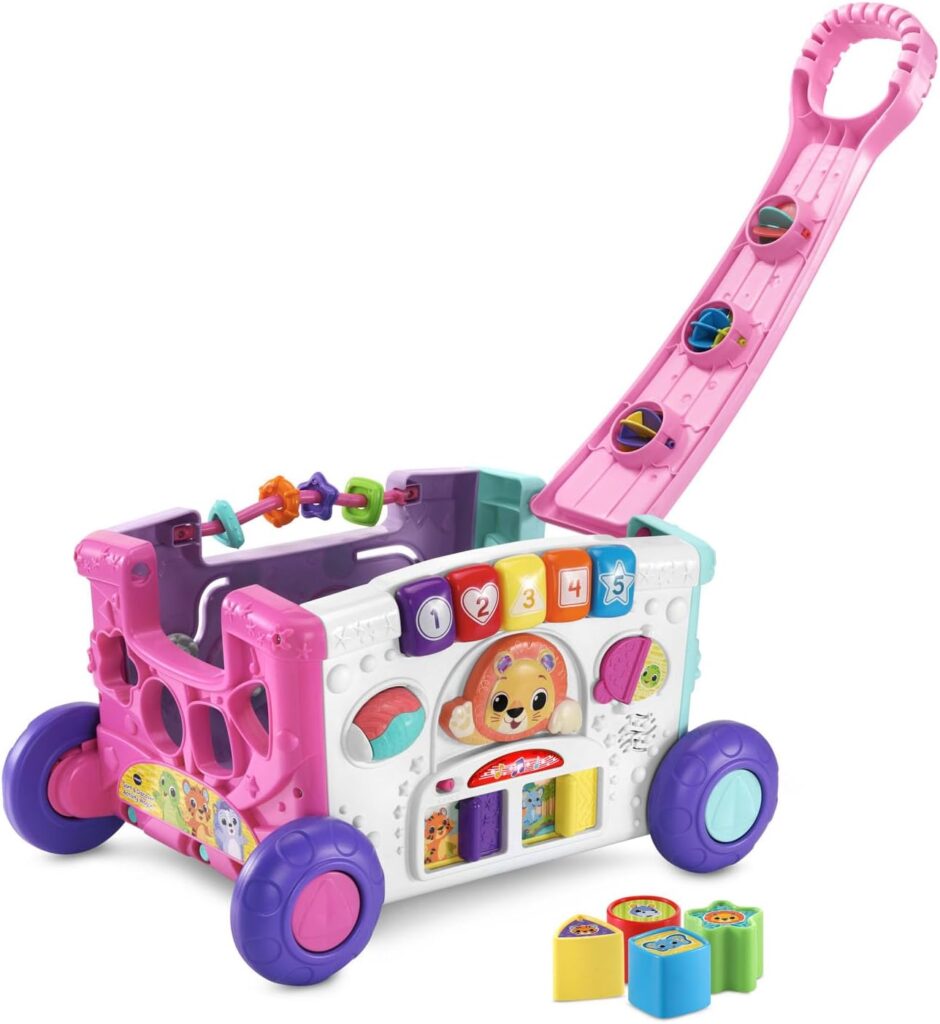
The wagon is built around a simple but thoughtful layout: activities on multiple exterior surfaces and an open interior compartment. The pink colorway gives it a distinct look, and the overall form factor is that of a small pull toy with a handle that folds over the top.
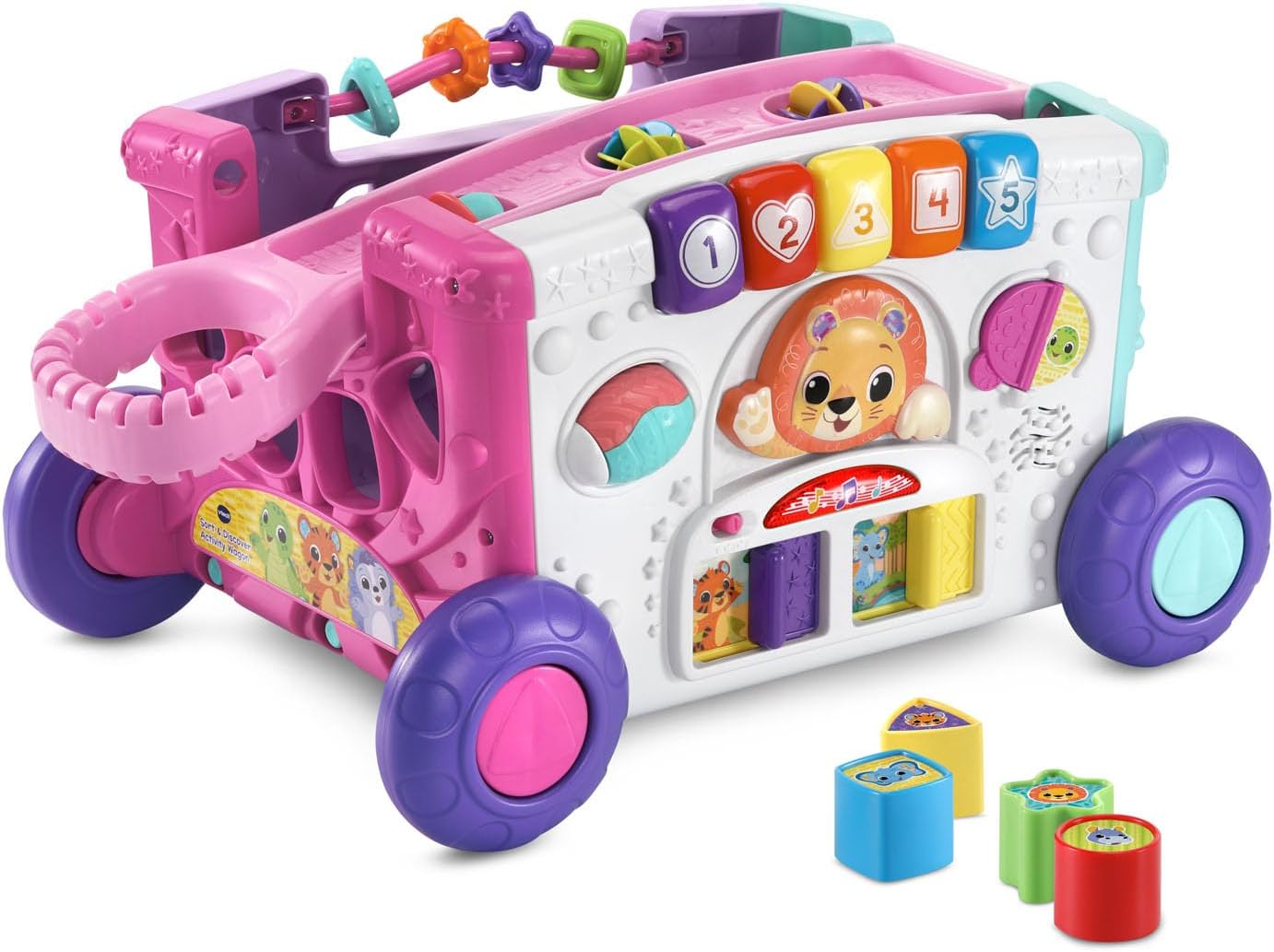
That folding handle matters more than it might first appear. When it is folded up, the wagon can be stored more compactly. When it is folded down, it becomes part of the play surface, effectively adding a fifth side with colorful spinners. This is a nice piece of design economy — the same component serves a travel function and a play function, so nothing on the wagon is wasted.
Because the product is intended for children as young as 12 months, the activities are scaled for small hands and are described as things little ones can flip, spin, slide, and sort. The source material does not specify materials, weight, or dimensions, so those details are best confirmed on the listing itself.
Features & Technology
The activity layout is split across the wagon’s sides, and each side offers something different. One side features a lion head, a colorful roller, and hidden animal friends waiting to be discovered through peek-a-boo doors. That same side includes activity keys that introduce colors, numbers, and more — an early-learning element that turns simple button pressing into a light educational moment.
The opposite side takes a more mechanical approach, with a bead maze, sliders, and interlocking gears to twist and turn. These are classic fine-motor activities: they encourage grasping, twisting, and manipulating small parts, which is a natural fit for the 12-to-36-month range.
Shape sorting appears twice, which is unusual and worth noting. The front and back sections each include different slots to match up the included blocks. Doubling up on shape sorting means two separate matching challenges rather than one, and it also spreads the activity around the wagon so a child does not have to crowd into a single spot to play.
On top of the physical activities, the wagon includes electronic elements. Pushing or pulling it rewards children with cheerful music and sound effects, which the source describes as enhancing playtime. This is a stated product feature rather than an independently verified performance claim, but it points to a clear design intention: to make movement itself feel like part of the game.
Performance & Everyday Experience
The most interesting thing about this wagon is how it changes as a child develops. For a younger toddler who is not yet walking, it works as a floor-play station. A child can crawl around it, flipping, spinning, sliding, and sorting their way around each activity. The activities are distributed across the sides, so there is a reason to move around the wagon rather than stay in one position.
As a child graduates to walking, the wagon’s role shifts. Now it becomes something to push or pull, and the interior compartment becomes useful. Favorite toys, snacks, and other items can be piled inside before heading out on a journey of discovery. That transition from stationary activity center to mobile companion is the wagon’s main practical appeal, and it is supported directly by how the product is described.
The electronic feedback ties into this stage as well. Because pushing or pulling triggers music and sound effects, the act of moving the wagon produces a response. For a toddler learning to walk and pull things along, that kind of cause-and-effect connection can make the toy more engaging than a silent pull cart.
One detail worth keeping in mind is that the handle does double duty. Folding it over for storage is convenient, but folding it down also creates the bonus spinner side. Parents who want to extend floor-play time can leave the handle in that position, while those packing the wagon away can fold it up. It is a small thing, but it reflects a design that anticipates more than one mode of use.
Battery & Compatibility
The wagon requires 2 AA batteries. Batteries are included, but the source notes they are for demo purposes only, and new batteries are recommended for regular use. That is a common arrangement with electronic toys: the included set is enough to demonstrate the sounds and music, but it is not intended to be the long-term power source. Parents should plan on having fresh AA batteries on hand for everyday play.
There is no app, pairing, or connectivity element described, so this is a self-contained toy. Its only compatibility consideration is the age range: it is intended for children 12 to 36 months.
Who Is This Product Best For?
This wagon suits families with a child in that 12-to-36-month window, particularly those who want a single toy that covers both floor play and early walking. The multi-sided activity layout gives younger toddlers plenty to explore before they are mobile, and the push-or-pull design gives older toddlers a reason to keep using it.
It also fits households where storage space is a consideration, since the handle folds up for convenient storage. And because the interior holds toys, snacks, and other items, it can serve as a small carry-along for a toddler who likes to bring things along.
It is less suited to children outside the stated age range, and it is not a ride-on toy — the source describes pushing or pulling, not riding.
Final Verdict
The VTech Sort and Discover Activity Wagon for Toddlers in Pink is a well-conceived activity toy that tries to stay useful across a broad developmental stretch. Its strengths are variety and adaptability: shape sorting on two separate sections, a bead maze, gears, sliders, activity keys, peek-a-boo doors, a lion head, and a colorful roller, plus music and sound effects triggered by movement. The fold-over handle adds storage convenience and a bonus play surface.
The main considerations are the battery requirement — 2 AA batteries, with the included set intended for demo purposes only — and the fact that it is designed for a specific age range of 12 to 36 months. Within that range, it offers a lot of different activities in one rolling package, and it transitions naturally from a floor-play center to a pull-along wagon as a child grows.