


Montessori Toys for 3 4 5 6 Year Old – Fine Motor Skills Toy Review
Wooden educational toys occupy a particular place in early childhood play. They tend to invite hands-on activity rather than passive entertainment, and they often turn ordinary routines into small learning moments. The INIFEIDALA Montessori apple picking tree toy fits squarely into that tradition. It is a wooden magnetic toy built around a fruit-picking theme, and it is aimed at children roughly between the ages of two and six, depending on which part of the listing you read. This review looks at what the toy is, how its features connect to one another, and which families may find it a useful addition to their playroom or classroom.
Design and Build
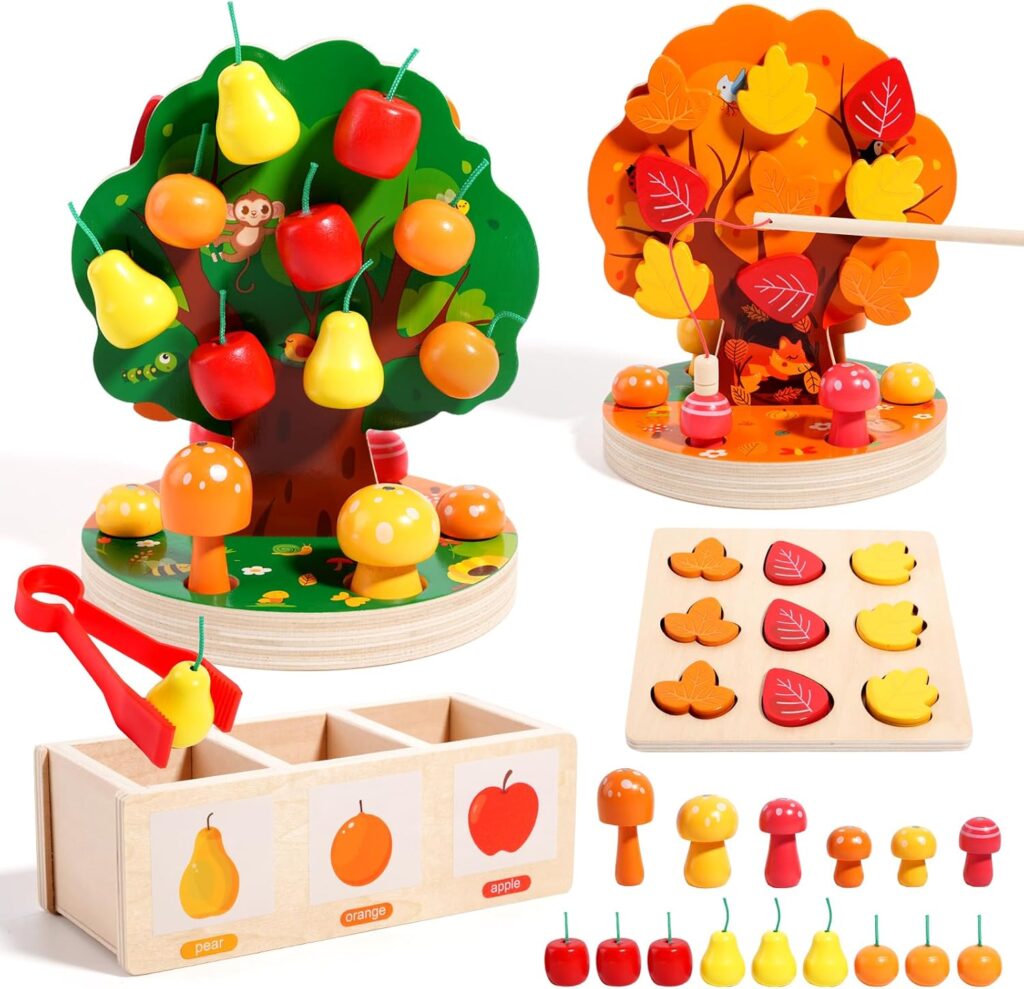
The core idea is simple and recognizable to anyone familiar with Montessori-style materials: a tree with fruit that can be picked. The set includes brightly colored fruits, leaves, and mushrooms, and the pieces are magnetic, so they can be lifted and moved with a magnetic tool rather than simply grabbed by hand. The listing specifically names apples, oranges, and pears among the fruit shapes.
Construction is described as natural wood finished with non-toxic, child-safe paint. The listing states that the toy is free from harmful chemicals, and it presents this as part of a safe and sustainable play experience. These are the manufacturer’s stated claims rather than independently verified results, but they are worth noting because parents of young children understandably pay close attention to what goes into a toy that will be handled, dropped, and occasionally mouthed.
The listing also describes the construction as durable, saying the materials are chosen to withstand enthusiastic play from busy little hands. Again, this is a stated product claim. What can be said with more confidence is that the design leans on wood rather than thin plastic, which is consistent with the kind of toy that is meant to be handled repeatedly during sorting and picking games.
Features and Learning Focus
The apple picking tree toy is organized around several overlapping learning goals, and it is worth unpacking how they relate.
- Life skills practice: Picking, sorting, and matching are presented as the central activities. These are the kinds of tasks that mirror everyday routines, which is part of why the toy is framed as a Montessori-style introduction to hands-on learning.
- Color and shape recognition: The variety of fruits, leaves, and mushrooms gives children distinct colors and forms to compare and group.
- Fine motor skills and hand strength: The magnetic pieces and the picking motion are described as helping children develop dexterity and coordination.
- Hand-eye coordination and concentration: The listing links the picking activity to both of these, since guiding a magnetic tool toward a specific piece requires focus and control.
The listing also refers to the toy as a tool for early STEM development and cognitive growth. That is a broad framing, but it is consistent with the sorting-and-matching nature of the play. The magnetic element is described as a strong magnet, which matters because the picking action depends on the magnet holding a piece securely enough to lift it.
Performance and Everyday Experience
In practice, a toy like this works best when the activity is clear without much instruction. A child sees fruit on a tree, sees a tool, and understands that the goal is to pick. That simplicity is one of the strengths the listing emphasizes, and it fits the Montessori approach of letting children work through a task with their own hands.
The sorting and matching elements add a second layer. Once the fruit is off the tree, it can be grouped by color or shape, which extends the play beyond the initial picking motion. The inclusion of leaves and mushrooms alongside the fruit gives more pieces to distinguish, which supports the color and shape recognition goal the listing highlights.
Because the toy is described as suitable for both home and classroom settings, it seems intended to work in group play as well as solo play. In a preschool or Montessori classroom, a sorting activity with clear visual categories can be set out as an independent work station. At home, it functions as a tabletop activity that a child can return to repeatedly.
One point worth flagging honestly: the age guidance in the listing is not entirely consistent. It is titled for ages three to six, describes the toy as designed for children three years and older, and elsewhere refers to suitability for kids two to four and three to five. Parents should treat the age range as approximate and use their own judgment about whether a particular child is ready for small magnetic pieces.
Gift Suitability and Who It Is Best For
The listing positions this as a gift for birthdays, Christmas, and educational toy collections, and it also mentions an Easter sensory bin context. That gives it a fairly wide gifting window across the year.
Based on the stated features, this toy is likely to appeal to:
- Parents of preschoolers looking for screen-free, hands-on activities
- Families following a Montessori approach at home
- Preschool and early years teachers building a sorting or fine motor station
- Anyone shopping for a wooden educational gift for a child in the rough two-to-six range
It is less obviously suited to older children, since the picking and sorting tasks are aimed at early development rather than sustained challenge. And as with any toy containing magnets and smaller pieces, supervision and age-appropriate judgment remain important.
Final Verdict
The INIFEIDALA Montessori apple picking tree toy is a coherent, purpose-built educational toy. Its strengths lie in the clarity of its concept: wooden construction with a child-safe finish, magnetic fruit pieces, and a picking-and-sorting activity that ties together fine motor practice, color and shape recognition, and concentration. The learning goals are not bolted on as an afterthought; they follow naturally from how the toy is designed to be used.
The caveats are modest but real. The age guidance varies across the listing, so buyers should read it as a general range rather than a precise recommendation. Claims about durability and safety rest on the manufacturer’s description rather than independent testing. Within those limits, this is a thoughtfully conceived wooden toy that fits comfortably into home playrooms and early years classrooms alike, and it makes a reasonable choice for families seeking a hands-on alternative to screen-based play.