

Fisher-Price Laugh & Learn Smart Stages Puppy Walker Review
Few toys try to do as much as the Fisher-Price Laugh & Learn Smart Stages Puppy Walker. On the surface it looks like a friendly puppy-themed walker, but the product information describes a toy designed to grow alongside a child from around six months to roughly three years. That is a wide span of development, and the walker attempts to cover it by offering two distinct ways to play and three learning levels that change as a baby matures. For parents looking at a single purchase meant to stay relevant through several stages of early childhood, this walker is positioned as exactly that kind of long-term companion.
Design & Build Quality
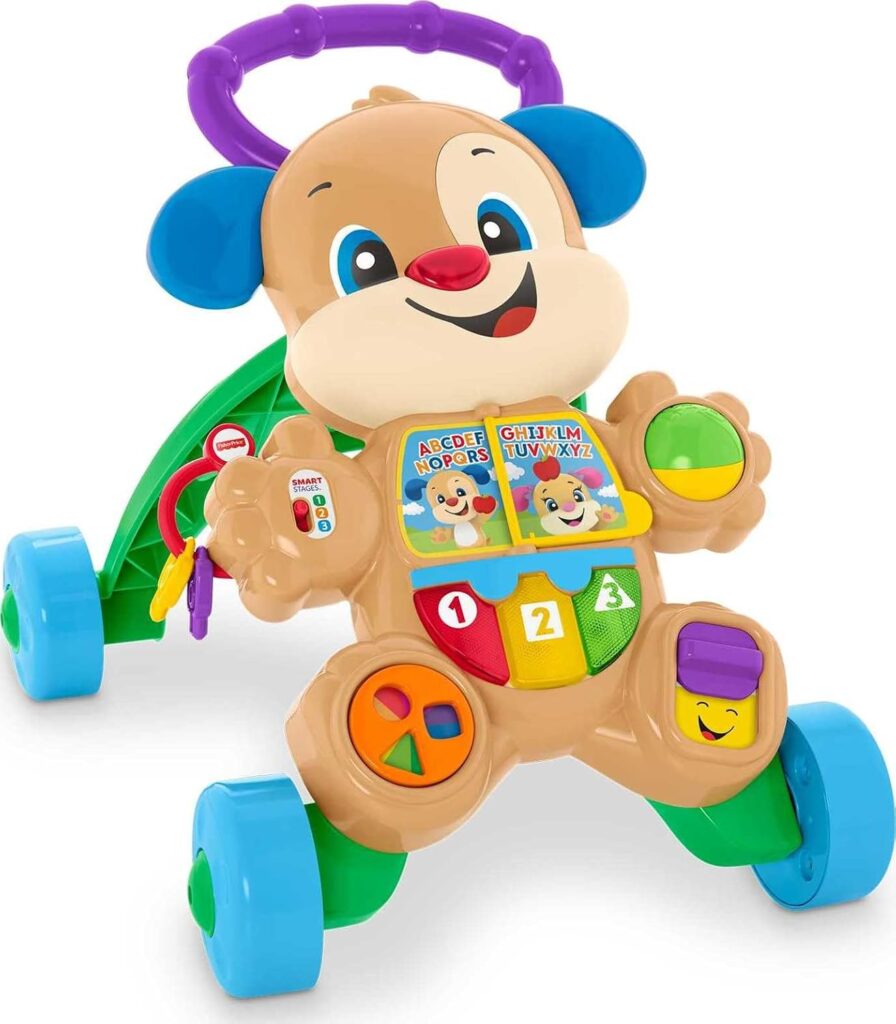
The walker is built around two physical ideas: a sit-and-play activity panel and a stand-and-walk frame. The product information describes an easy-grasp handle paired with a sturdy, four-wheel base. Those two elements work together to help steady a baby’s first steps, according to the stated design. The four-wheel configuration is a deliberate choice for a walker aimed at beginners, since it gives the toy a wider footprint than a two-wheel design would, and the handle is shaped so small hands can hold on comfortably while pushing.
On the front of the walker sits an activity panel with seven hands-on features. These include light-up piano keys and a light-up nose, plus a roller, a spinner, and a flip page, among others. Each of these elements is meant to be reached for, pressed, spun, or flipped, which is why the toy is described as offering hands-on activities for little sitters as well as support for those first steps. The puppy theme runs through the whole design, giving the walker a character-like presence rather than the look of a plain push toy.
Features & Technology
The headline feature is the Smart Stages system. Rather than locking a child into one set of content, the walker offers three learning levels that introduce the alphabet, shapes, colors, counting, and even Spanish words. The product information states that the toy includes more than 75 songs, sounds, and phrases across these levels. That figure matters because it suggests the content is spread across the stages rather than concentrated in a single mode, so the walker can keep offering something new as a child moves from one level to the next.
The two ways to play are closely tied to those stages. A younger baby who is not yet mobile can sit and interact with the panel, reaching for the piano keys, the roller, the spinner, and the flip page. An older baby who is pulling up to stand can use the handle and the four-wheel base to walk behind the toy. The same activity panel stays within reach in both positions, which means the learning content does not disappear when a child transitions from sitting to walking.
Cause and effect is another stated part of the experience. Babies discover that pressing the buttons or pushing the walker along activates music and phrases. That is a simple but meaningful mechanic for infants, because it links an action they can perform with an immediate result they can hear. The light-up piano keys and nose add a visual response to the same idea, reinforcing the connection between what a baby does and what happens next.
Performance & Everyday Experience
In everyday use, the walker is designed to serve two very different moments in a baby’s routine. During floor time, it functions as a stationary activity center where a sitter can explore the panel. During more active play, it becomes a push toy that a baby can use while practicing standing and walking. Because the product information describes the walker as helping strengthen both fine and gross motor skills, the two modes are not just separate features but complementary ones. Fine motor skills come into play when a baby grabs the roller or flips the page; gross motor skills come into play when a baby pulls up and pushes the walker forward.
The musical element is woven through both modes. With more than 75 songs, sounds, and phrases, the walker is intended to keep the experience varied rather than repetitive. The three Smart Stages levels mean the content is meant to shift as a child grows, introducing the alphabet, shapes, colors, counting, and Spanish words at the appropriate level. That progression is the core of the toy’s appeal for families who want a single item to remain engaging over a long period.
Compatibility & Age Range
The walker is described as suitable for infants and toddlers ages 6 to 36 months. That range covers a substantial period of development, from a baby who is just beginning to sit and reach, to a toddler who is walking confidently. The two play modes map naturally onto that range: sit and play for the earlier months, stand and walk for the later ones. The three Smart Stages levels provide a further layer of adjustment within that window, so the toy is intended to change with the child rather than being outgrown quickly.
Who Is This Product Best For?
This walker is best suited to families with a baby in the 6-to-36-month range who want a toy that supports both seated play and early walking. Parents looking for a single item that can transition from a floor activity center into a push walker will find that dual purpose built directly into the design. It is also a reasonable fit for households that want early exposure to the alphabet, shapes, colors, counting, and Spanish words through music and phrases, since those topics are explicitly part of the Smart Stages content. Caregivers who value hands-on activities such as piano keys, a roller, a spinner, and a flip page will find those elements included as well.
Final Verdict
The Fisher-Price Laugh & Learn Smart Stages Puppy Walker is a thoughtfully structured toy that tries to stay useful across a long stretch of early childhood. Its two play modes address sitting and walking, while the three Smart Stages levels and more than 75 songs, sounds, and phrases are intended to keep the learning content moving forward as a baby develops. The seven hands-on activities, including the light-up piano keys and nose, give little ones plenty to reach for and interact with, and the easy-grasp handle and sturdy four-wheel base are designed to help steady those first steps. For parents who want one toy to cover both motor skill development and early learning topics from around six months to three years, this walker offers a clear and well-defined answer.