



Youuys Baby Tissue Box Toy for Babies 6–12 Months: A Montessori Sensory Toy That Redirects the Tissue-Pulling Habit
Few daily routines with a baby are as predictable as the tissue box disappearing act. A baby spots the box, reaches in, and pulls one sheet after another until the floor is covered. The Youuys Baby Tissue Box Toy approaches that habit from a different angle. Instead of trying to stop the behavior, it gives babies a dedicated outlet for it — a soft cloth cube filled with colorful scarves and crinkle tissues that can be pulled out and stuffed back in as many times as a baby likes.
Marketed as a Montessori-inspired sensory toy for babies roughly 6 to 12 months old, the set combines a pull-and-play activity with a multi-sided activity cube. It is a straightforward concept, and the product information describes it in enough detail to understand what a parent is actually getting.
Design and Build Quality
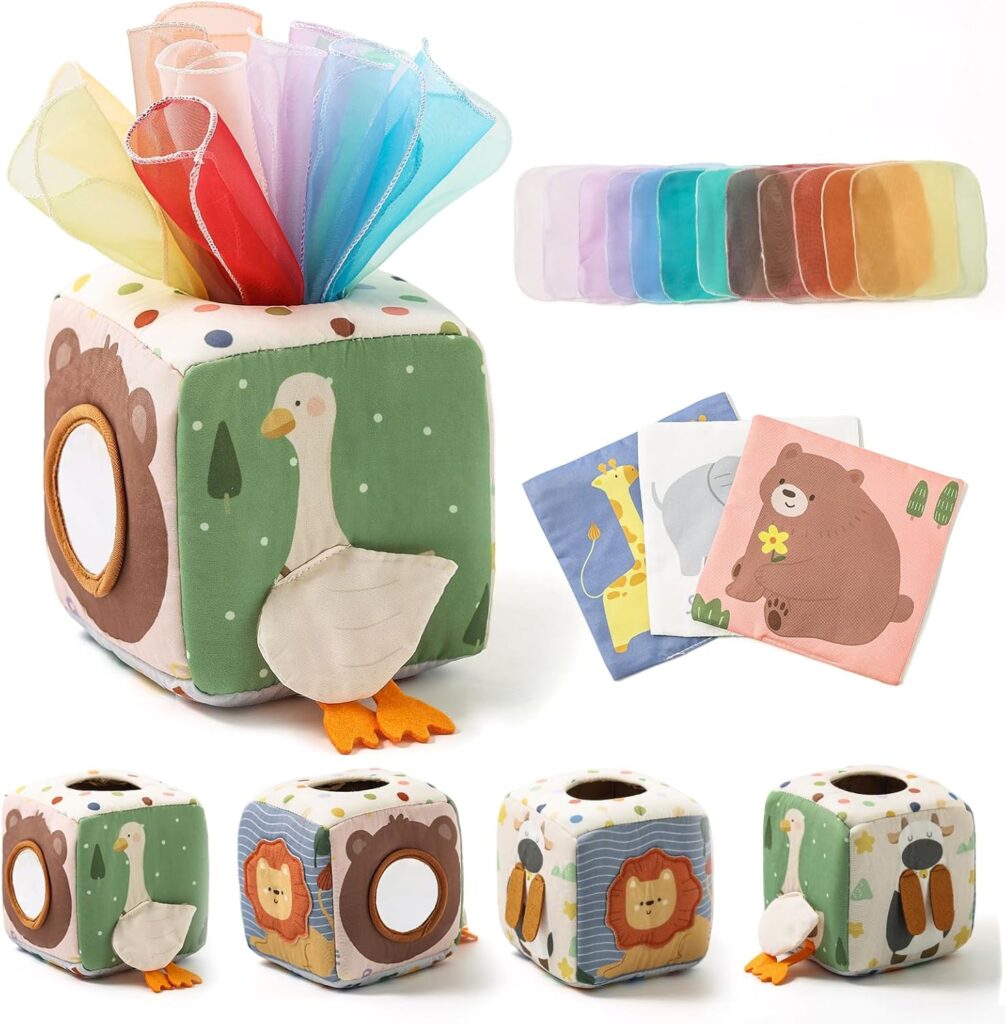
The centerpiece is a cube made from soft, non-toxic woven cloth. According to the product information, the cube uses reinforced stitching and contains no sharp edges or hard parts. That cloth construction matters for a toy aimed at an age group that explores largely by mouth and by grabbing, since there is no rigid shell or exposed hardware described in the design.
The cube is also described as collapsible. A soft, foldable structure is easier to pack than a rigid box, which is why the listing positions it as a lightweight travel toy for use in a car or on a plane. The set is packaged attractively, which supports its stated role as a gift option.
Inside the cube are 12 soft, colorful scarves and 3 crinkle tissues. These are the reusable stand-ins for paper tissues, and they form the core of the toy’s main activity.
Features and Technology
The product information describes six interactive sides, each with a different activity. Among the elements named are a baby-safe discovery mirror, a high-contrast crinkling duck, textured bear “hands,” and a tactile lion. The remaining sides round out the cube’s multi-sensory layout.
These features point to three sensory channels working together. The crinkling elements address sound, the mirror and high-contrast duck address visual interest, and the textured bear hands and tactile lion address touch. The stated intent is to promote auditory and visual development while encouraging tactile exploration.
The mirror is described as soft and shatter-proof. For a toy intended for babies who handle objects roughly, that description is a relevant design detail rather than a performance claim.
Performance and Everyday Experience
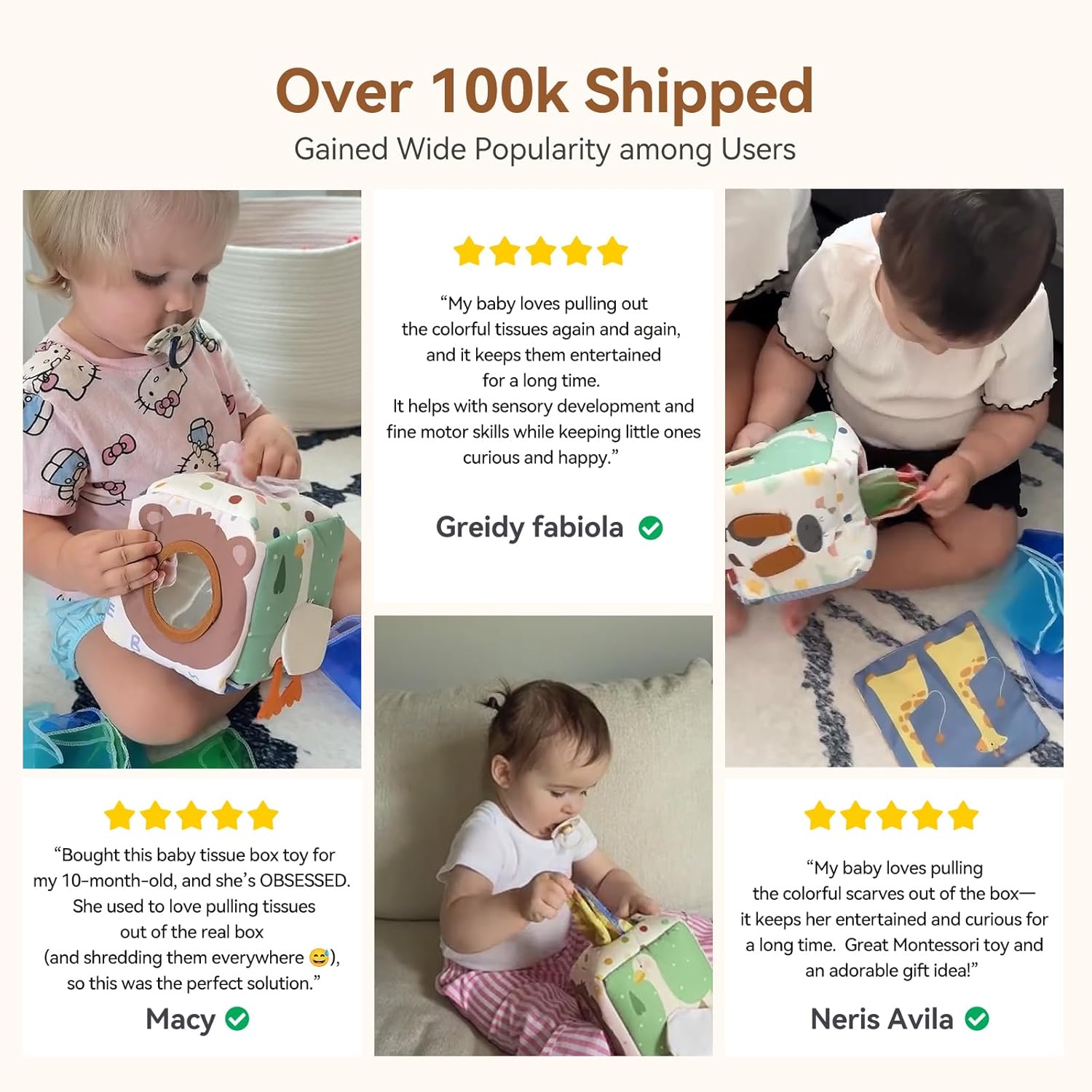
The practical appeal of this toy comes down to one repetitive motion: pulling. Babies in the 6-to-12-month range tend to repeat actions that produce an interesting result, and a scarf emerging from a box is exactly that kind of result. The Youuys set leans into this by supplying scarves and crinkle tissues that can be pulled out and then stuffed back in.
That second half of the cycle — stuffing the scarves back into the cube — is where the toy distinguishes itself from a plain tissue box. The product information describes this back-and-forth as a workout for tiny hands that is stated to improve hand-eye coordination and fine motor skills, and to lay a foundation for later grasping and writing. Those are the manufacturer’s stated developmental goals rather than measured outcomes, but the activity itself is easy to picture: reach, grip, pull, release, repeat.
For parents, the more immediate benefit is the one stated up front. Replacing paper tissues with 12 reusable scarves and 3 crinkle tissues means the pull-and-play instinct gets redirected into a toy instead of a box of wipes. The product information frames this as saving cleanup time and money, which follows directly from the fact that the scarves are reusable rather than disposable.
Because the cube offers six different sides, the toy does not depend on a single activity to hold attention. A baby can move from the mirror to the crinkling duck to the textured panels without leaving the same object, which is useful for a toy meant to be revisited throughout the day.
Safety, Certification, and Compatibility
The product information states that the entire toy set has been independently tested and passed US-based CPC (Children’s Product Certificate) certification. That certification is a stated part of the listing, and it is paired with the description of soft woven cloth, reinforced stitching, and the absence of sharp edges or hard parts.
On age suitability, the title positions the toy for babies 6–12 months, while the gift section extends the suggested range to 6, 9, 12, and 18 months. The toy is described as suitable for both boys and girls. There is no battery, no charging, and no app or connectivity element described — this is a purely physical, cloth-based toy, which keeps it simple to use and easy to bring along.
Who Is This Product Best For?
This toy suits parents and caregivers of babies in the 6-to-12-month window who are dealing with the tissue-pulling habit and want a reusable alternative. It also fits households looking for a Montessori-inspired sensory toy that combines fine motor practice with visual, auditory, and tactile elements in one object.
Because the product information highlights the packaging and names a 1st Birthday, Christmas, or Baby Shower as occasions, it is also a reasonable option for gift-givers shopping for 6, 9, 12, or 18-month-old boys and girls. Families who travel or want quiet entertainment in a car or on a plane may find the collapsible cloth design convenient, since it is described as lightweight and packable rather than rigid.
Final Verdict
The Youuys Baby Tissue Box Toy takes a familiar, slightly frustrating baby behavior and builds a product around it. The cloth cube, 12 scarves, and 3 crinkle tissues create a pull-and-stuff loop that is reusable, while the six activity sides add variety through a soft mirror, a crinkling duck, textured bear hands, and a tactile lion. The stated CPC certification and the soft, non-toxic woven cloth construction with reinforced stitching address the safety side of the equation for a toy aimed at babies who put things in their mouths.
The developmental claims about fine motor skills and hand-eye coordination come from the manufacturer rather than from independent measurement, so they are best read as the intended purpose of the design. What the product information supports clearly is a well-thought-out sensory toy that redirects a common habit, offers multiple activities in one soft package, and travels easily. For parents in the 6-to-12-month stage, that combination is a sensible fit.