





WiFi Wireless Alarm System for Home Security – 24/7 Protection Smart Device
Home security has evolved well beyond the simple keypad-and-keychain systems that dominated the market for years. The modern approach leans heavily on connectivity, app-based control, and the kind of flexibility that lets a system adapt to the way you actually live. The WiFi Wireless Alarm System for Home Security aims to deliver that experience with a feature set that covers voice control, multiple arming methods, and a design philosophy that emphasizes ease of use. This review takes a closer look at what this system offers, how it is meant to be used, and who might benefit most from its particular combination of features.
Design & Build Quality
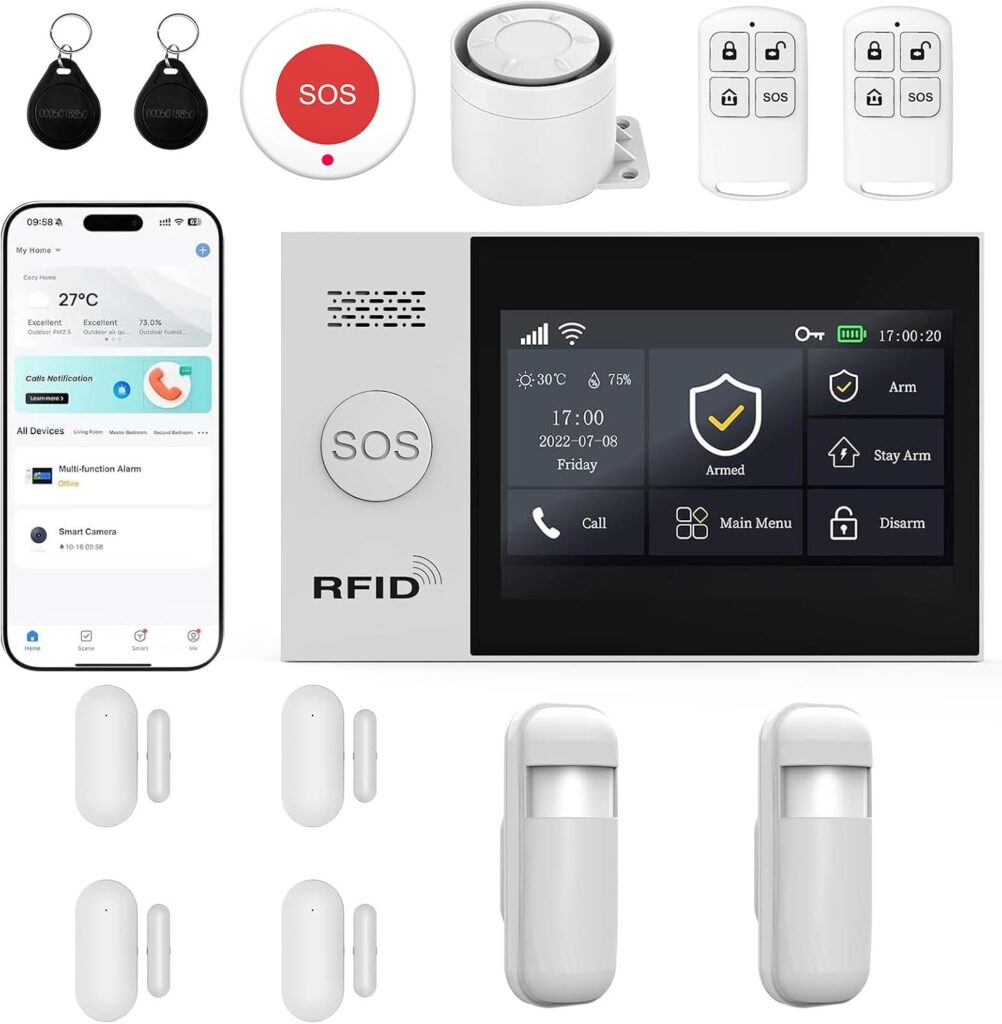
The most immediately noticeable design element here is the 4.3-inch color touch screen interface. Instead of the traditional numeric keypad with a small monochrome display, this system puts a full-color screen at the center of the control experience. The screen is designed to show the system’s status, the current time, and alerts in real time, which makes the base station feel more like a modern smart home hub than a conventional alarm panel.
The interface is described as user-friendly, with a multilingual menu that includes English, Chinese, German, French, Spanish, Italian, Portuguese, Polish, Greek, and more. That level of language support is a practical consideration for households where not everyone is equally comfortable with a single language, and it also points toward a system that is intended to be approachable for a wide range of users. The touch screen is specifically described as being easy to use even for children and the elderly, which suggests the layout and menu structure were designed with accessibility in mind rather than just technical capability.
In terms of physical setup, the system is wireless and does not require wiring for installation. The stated installation time is 10 to 15 minutes, which aligns with the DIY positioning of the product. The kit includes a siren, an SOS button, a remote, sensors, and an RFID card, so the core components needed to get started are present in the box.
Features & Technology
One of the standout claims for this system is its multi-layered approach to connectivity. It supports 2.4GHz WiFi as well as 2G/4G connections, with 5G networks not supported. This dual connectivity is intended to provide stable and reliable transmission, and the system is stated to send instant notifications via app, SMS, or voice call. It is important to note that SMS notifications and voice intercom functionality require a SIM card, which is sold separately. Without a SIM card, the product cannot receive calls, and the system will not function without both a SIM card and an active network connection. However, notifications can still be received through the Smart Life app over WiFi.
The system is also designed to work with voice control through Alexa and Google Assistant. This integration allows users to manage alarms and monitor entry points using voice commands, which adds a layer of convenience for those who already use smart speakers or displays in their home. The phrase “smart home safety” is used in the product description, and the voice control capability is a clear step toward that goal.
Control options are not limited to the touch screen and voice. The system supports four distinct operation methods: the touch screen itself, a mobile app for both iOS and Android, a remote, and an RFID card. Having multiple ways to arm and disarm the system is genuinely useful in practice. A remote can be kept on a keychain for quick access, an RFID card might be left in a bag or wallet, and the app is always available on a phone. This redundancy means there is likely to be a control method that fits the moment, whether you are walking out the door, arriving home with hands full, or sitting on the couch.
The system is also designed to support a substantial number of sensors. The product information states that it can connect up to 100 devices, including doors, windows, motion sensors, and more. All of these can be managed through a single app, which is intended to provide full control and total protection across the home. The sensors themselves can be placed up to 393 feet (approximately 120 meters) away from the alarm panel base station, which gives a generous range for most residential layouts.
Performance & Everyday Experience
The product description emphasizes speed and responsiveness, using phrases like “70% faster” and “100% safer,” along with claims of no delays and no freezing. These are marketing statements rather than independently verified performance metrics, but they do indicate the intended user experience: instant alerts and a system that responds quickly to events. The description also mentions that the system sends motion alerts, reinforcing the idea that sensors are meant to provide real-time awareness of activity around the home.
One of the more interesting aspects of this system is the guidance provided on sensor installation for different arming modes. The product information includes a specific note about Away Arming and Home Arming modes. When you are at home, the recommendation is to use Away Arming to detect outdoor intrusions, which means installing compatible sensors indoors. Conversely, when you are away, the recommendation is to use Home Arming to protect indoor property, which means installing compatible sensors outdoors. This is a somewhat counterintuitive pairing of mode names and sensor locations, but it is clearly explained in the product information, and it highlights the importance of understanding how the system is meant to be configured for different scenarios.
The system is also described as “care-driven security,” with a focus on being safer for children, safer for aging parents, and safer against intruders. This positioning suggests that the system is not just about deterring burglaries but also about providing peace of mind for households with vulnerable members. The inclusion of an SOS button is a practical feature in this context, as it provides a way to trigger an alert manually in an emergency.
Battery & Power Protection
Power continuity is a critical concern for any security system, and this product addresses it with an integrated battery backup. The alarm panel is designed to be plugged into a power outlet for daily use and charging. In the event of a power outage, the backup battery is stated to last between 4 and 8 hours. This is not an indefinite solution, but it does provide a window of continued operation during a blackout, which is often precisely when a security system is needed most.
The product information also mentions immediate alerts for sabotage, which suggests that the system is designed to detect tampering or forced attempts to disable it. This is a meaningful feature for a security device, as it addresses the scenario where an intruder might try to physically compromise the system.
Who Is This Product Best For?
Based on the supplied information, this system appears well suited for households that want a DIY security setup without ongoing costs. The absence of monthly fees is a recurring theme in the product description, and the system is designed to function as a standalone solution once the hardware is in place. The only potential ongoing cost is a SIM card if you want SMS notifications and voice call features, and that is optional depending on your needs.
The multilingual interface and the stated ease of use for children and the elderly make this a reasonable option for multi-generational households. The voice control integration with Alexa and Google Assistant will appeal to those who already use those platforms. The ability to share access with family members through the app is also a practical feature for households where multiple people need to arm, disarm, and monitor the system.
Given the support for up to 100 sensors, this system could scale to cover a larger home or a property with many entry points. The stated sensor range of 393 feet from the base station provides flexibility in sensor placement, though the installation guidance for different arming modes should be followed carefully to ensure the system operates as intended.
Final Verdict
The WiFi Wireless Alarm System for Home Security brings together a modern touch screen interface, voice control compatibility, multiple arming methods, and support for a large number of sensors in a package that is designed for straightforward DIY installation. The dual WiFi and 2G/4G connectivity provides flexibility, though the requirement for a SIM card and active network connection for full functionality is an important consideration. The backup battery offers a stated 4 to 8 hours of continued operation during a power outage, which adds a layer of resilience.
The system’s emphasis on accessibility, with its multilingual menus and multiple control options, makes it a versatile choice for a range of users. The guidance on sensor placement for different arming modes is a useful detail that suggests careful thought has gone into the system’s design. While the marketing language around speed and safety should be taken as stated claims rather than verified facts, the feature set is comprehensive and the system appears to be a solid option for those seeking a customizable, no-monthly-fee security solution.