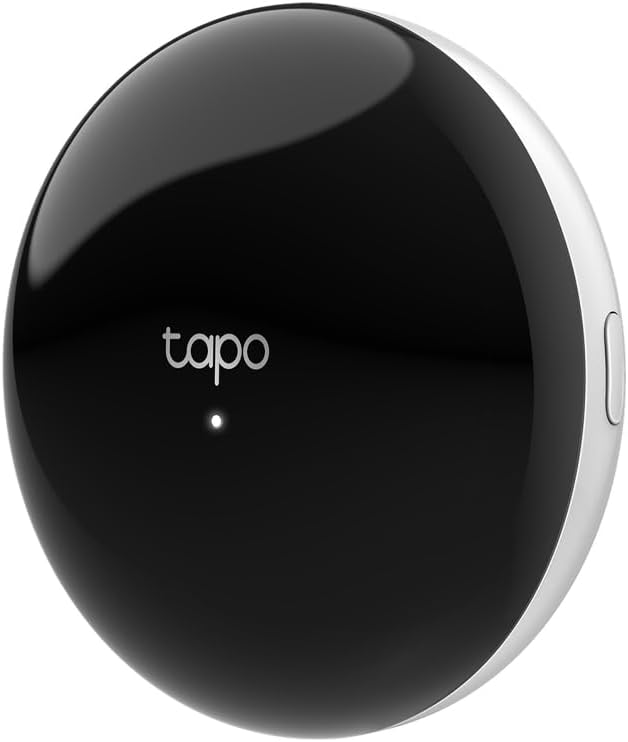


Tapo Smart IR & IoT Hub with Chime, Matter-Certified, H110: A Universal Remote and Automation Hub in One
Smart homes tend to accumulate devices the way garages accumulate boxes. A few smart plugs here, a couple of sensors there, a doorbell camera, and suddenly you are juggling several apps and a coffee table covered in infrared remotes. The Tapo Smart IR & IoT Hub with Chime, model H110, is designed to address that exact situation. It combines three roles into a single compact device: a Matter-certified hub for Tapo smart devices, a built-in chime for notifications and alarms, and a universal infrared remote capable of controlling a wide range of appliances. Rather than adding another layer of complexity, the H110 is positioned as a command center that consolidates control across both modern connected devices and older infrared electronics.
Design and Build Approach
The H110 is described as a compact command center, and its role in the home reflects that description. It is meant to sit somewhere central, quietly coordinating sensors, cameras, smart plugs, and infrared-controlled appliances rather than calling attention to itself. The package includes the hub itself, a USB-C power cable, and a Quick Start Guide.
One practical detail worth noting up front: the H110 requires a 5V⎓2A USB power adapter, which is not included and is sold separately. That is a small but important consideration for anyone planning a setup, since the hub cannot operate without it. The device is FCC-certified, and TP-Link states that it is designed, built, and maintained with advanced security as a core requirement, noting the company’s status as a signatory of the U.S. Cybersecurity and Infrastructure Security Agency’s Secure-by-Design pledge.
Environmental tolerances are also specified. The hub operates between 32°F and 104°F (0°C to 40°C) and at humidity levels up to 90 percent, non-condensing. Those figures describe everyday indoor conditions rather than extreme environments, which fits the intended placement of a hub that needs to stay within range of both your Wi-Fi network and the infrared appliances it controls.
Features and Technology
The core appeal of the H110 is its three-in-one functionality. As an IoT hub, it acts as the automation backbone for Tapo sensors, handling open-close events, motion detection, temperature changes, and similar triggers. As a chime, it provides customizable audio cues for notifications, smart alarms, and doorbells without requiring a separate third-party speaker. As an infrared remote, it reaches beyond the smart home ecosystem entirely.
That infrared capability is broader than many users might expect. The H110 supports 18 appliance types, including TVs, air conditioners, set-top boxes, robot vacuums, fans, lights, air purifiers, humidifiers, water heaters, electric heaters, electric curtains, projectors, amplifiers, DVD players, cameras, foot tubs, drying racks, and box devices. Across those categories, TP-Link states compatibility with more than 8,000 brands of infrared-controlled electronics. For households holding onto legacy devices that predate app control, the hub also supports IR learning, which allows it to capture commands from an existing remote and bring those appliances into smart routines.
Matter certification is a significant part of the pitch. The H110 works with Amazon Alexa, Google Assistant, and Apple Home through Matter, positioning it as an interoperability layer across major platforms. It is worth noting that a Matter controller, such as a HomePod, Nest Hub, Echo, or SmartThings Station, is required for setup. That is a prerequisite rather than an optional extra, so buyers should confirm they already have a compatible controller before committing.
Performance and Everyday Experience
In daily use, the H110 is built around responsiveness and continuity. TP-Link describes rapid, low-latency alerts for sensor events, which matters most for motion detection and door or window activity, where a delayed notification is nearly useless. The built-in alarm is rated at 93 dB, and the hub supports customizable tones, so different events can sound distinct from one another.
Local processing is another stated feature. Core automations are designed to continue even during internet outages, which means routines tied to sensors and local devices can keep functioning when connectivity drops. That is a meaningful distinction for anyone who relies on automations for everyday convenience rather than novelty.
The Tapo app, available for iOS 12 and later and Android 6.0 and later, handles onboarding, IR setup, and automation building. Pairing older appliances is done by scanning or mapping remote buttons within the app, which the company describes as a quick learning process. Beyond manual control, the app supports scheduling and location-based automation. Appliances can be set to power on or off based on GPS detection, so an air conditioner might start cooling before you arrive home, or devices can shut down automatically once you leave. Schedules can be tailored to daily routines, such as pre-cooling rooms in the morning or powering down televisions at bedtime.
Remote access through the app extends control beyond the home. Forgotten appliances can be switched off from anywhere, and air conditioning settings can be adjusted before arrival. Voice commands through Alexa, Google Assistant, or Siri allow hands-free adjustments like changing temperature or switching channels without reaching for a remote or phone.
Connectivity and Compatibility
The H110 connects over 2.4 GHz Wi-Fi and requires a Matter controller for setup. Its compatibility story has two distinct halves. On the smart home side, it unifies Tapo devices including sensors, cameras, and smart plugs, and integrates with the three major voice ecosystems via Matter. On the infrared side, it reaches thousands of brands across the 18 supported appliance types, with IR learning available for devices that are not directly listed.
Because Matter support is central to the design, the hub is positioned as a system built to stay compatible as a smart home grows. That framing is about platform interoperability rather than any specific performance guarantee, and it reflects the stated purpose of Matter certification rather than an independently verified outcome.
Who Is This Product Best For?
The H110 suits households that have accumulated a mix of Tapo devices and infrared-controlled appliances. If you already own Tapo sensors, cameras, or plugs, the hub serves as the automation backbone that ties them together while adding chime functionality in the same unit. If you have older televisions, air conditioners, fans, or similar electronics that respond only to infrared remotes, the universal remote function and IR learning offer a way to fold those devices into app-based and voice-controlled routines.
It is also a reasonable fit for anyone who wants cross-platform flexibility. Because the H110 works with Alexa, Google Assistant, and Apple Home through Matter, it does not lock users into a single ecosystem. However, prospective buyers should already own or plan to acquire a Matter controller, since setup depends on one. Those without a compatible controller, or without a 5V⎓2A USB adapter on hand, will need to account for both before the hub can be used.
Final Verdict
The Tapo Smart IR & IoT Hub with Chime, H110, takes a sensible approach to a familiar problem. Instead of asking users to manage separate hubs, chimes, and infrared blasters, it consolidates those roles into one Matter-certified device with local processing, a 93 dB alarm, and support for 18 appliance types across thousands of infrared brands. The inclusion of IR learning gives legacy devices a path into modern automation, while Matter support keeps the hub aligned with the major voice platforms.
The caveats are straightforward and worth weighing. A Matter controller is required for setup, and the necessary USB power adapter is not included. Environmental tolerances are specified for typical indoor conditions, and the hub depends on 2.4 GHz Wi-Fi. For households already invested in Tapo devices or holding onto infrared appliances they would rather not replace, the H110 offers a coherent way to bring both worlds under one roof.