
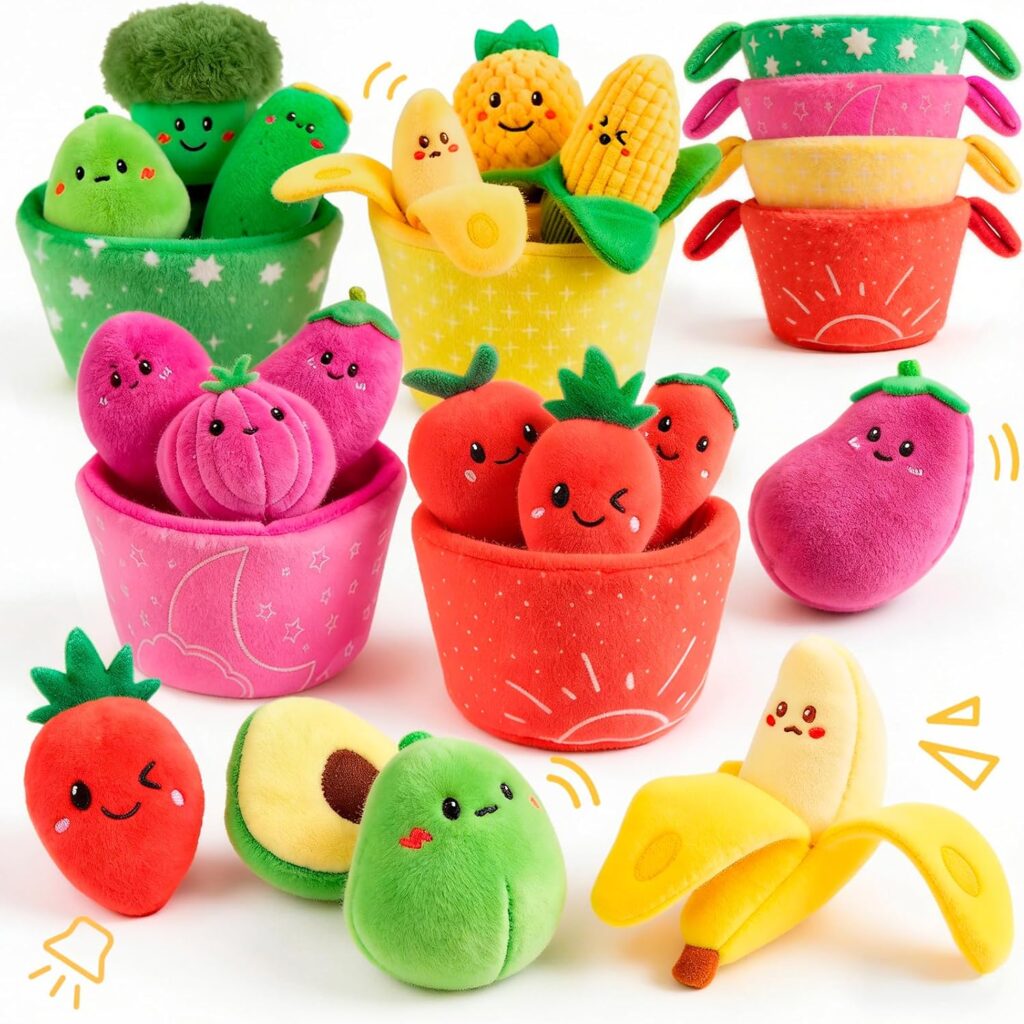


SAIMAND Baby Toys 6–12 Months: A 16-Piece Montessori Plush Sensory Play Food Set
Choosing toys for a baby in the second half of their first year often comes down to a simple question: will this hold their attention while actually doing something useful for their development? The SAIMAND Baby Toys 6–12 Months set approaches that question with a 16-piece collection of plush fruits and vegetables, presented as a Montessori-inspired sensory play food set. Rather than relying on screens, lights, or complex electronics, it leans on textures, sounds, and hands-on activities that babies can explore at their own pace.
This review walks through what the set includes, how its sensory features are intended to work, and which families may find it a good fit. Everything below is based on the manufacturer’s stated product information, so where a detail isn’t specified, it’s left out rather than assumed.
Design & Build Quality
The core of the set is its 16 plush fruit and vegetable pieces, accompanied by vibrant baskets that give the collection a sorting and storage element. The design is clearly aimed at very young children: the pieces are soft rather than rigid, and the brand states that all parts are securely stitched with no small pieces or sharp edges. That construction detail matters for a product intended for babies from six months upward, an age when mouthing and grabbing are constant.
The set is also described as meeting US safety standards, specifically CPC, ASTM, and CPSIA. These are stated claims from the manufacturer rather than independent findings, but they indicate the product is positioned to comply with recognized children’s toy requirements. For cleaning, the plush toys are listed as surface washable, and the set includes a barn mat that the brand describes as easy to clean. The mat adds a defined play surface, which can help keep the fruit-and-vegetable play contained to one area.
Features & Technology
What separates this set from a plain collection of soft toys is the sensory engineering built into each piece. According to the product information, every fruit and vegetable features crinkle paper, rattles, and varied soft textures. In practice, that means a baby exploring the set encounters more than one kind of feedback: a crinkling sound when a piece is squeezed, a rattle sound when it’s shaken, and different surface feels from piece to piece. For a six-to-twelve-month-old, that variety is the point — it gives them reasons to reach for one item, then another.
The activities are framed around Montessori principles. Peeling, squeezing, and pouring are the named play patterns, and the brand links them to fine motor skills, hand-eye coordination, and early problem-solving. These are reasonable descriptions of what the actions involve: peeling and squeezing work the fingers and hands, while pouring and moving pieces between containers encourage coordination. The set also supports color recognition and sorting, since the plush pieces come in vibrant colors and the baskets provide a natural way to group and match them.
Performance & Everyday Experience
In day-to-day use, this is a toy designed for independent exploration. The combination of sounds and textures means a baby can stay engaged without an adult directing every moment, while the sorting and matching possibilities give caregivers an easy way to join in when they want to. The baskets serve double duty here — they’re part of the color-sorting play and a practical way to gather the pieces afterward.
Because the set spans fruits and vegetables, it also introduces early food vocabulary and recognition during play. The brand positions the collection as “My First Sensory Fruits & Veggies,” which reflects its role as an introductory set rather than a more advanced pretend-play kit. The barn mat rounds out the experience by giving the pieces a home base during play sessions.
It’s worth being clear about what this set is not. There are no electronic components, no lights, and no app connectivity described. The engagement comes entirely from the physical properties of the plush pieces — crinkle, rattle, texture, and color. For families who prefer open-ended, low-tech play, that’s a defining characteristic rather than a limitation.
Cleaning & Compatibility
Maintenance is straightforward according to the supplied information: the plush toys are surface washable, and the barn mat is described as easy to clean. That’s a practical detail for a product that will spend time on floors and in the hands (and mouths) of babies. No machine-washing instructions are provided, so surface cleaning is the stated method to follow.
The set is intended for babies, infants, and toddlers from 6–12 months, with the brand also referencing 1-year-olds. It doesn’t rely on batteries, pairing, or any other compatibility requirements, so it can be used straight out of the box wherever there’s floor space for play.
Who Is This Product Best For?
Based on the stated age range and features, this set suits a few clear situations:
- Parents of babies aged roughly 6–12 months who want a sensory toy that engages multiple senses through sound and texture.
- Families interested in Montessori-style play that emphasizes hands-on activities like peeling, squeezing, and pouring over electronic features.
- Caregivers looking for a toy that supports color recognition and sorting as a baby moves toward toddlerhood.
- Anyone shopping for a baby shower, first birthday, Easter, or Christmas gift, since the brand lists these as intended occasions.
The 16-piece format also makes it a candidate for households that want a single set covering both sensory play and early sorting, rather than several separate toys.
Final Verdict
The SAIMAND Baby Toys 6–12 Months set is a thoughtfully structured sensory toy built around a simple idea: give babies soft, sound-making, textured pieces and let their hands and curiosity do the rest. The 16 plush fruits and vegetables, the crinkle and rattle elements, the sorting baskets, and the barn mat work together as a coherent play system rather than a random assortment. The stated safety compliance and surface-washable care instructions address two of the practical concerns parents tend to have with plush toys for this age group.
Its strengths lie in variety and open-ended play — multiple textures, multiple sounds, and multiple ways to sort and match. Families who want lights, music, or app-connected features won’t find them here, and that’s by design. For parents seeking a Montessori-inspired, hands-on sensory set for a baby approaching their first birthday, this collection offers a well-defined option worth considering.