
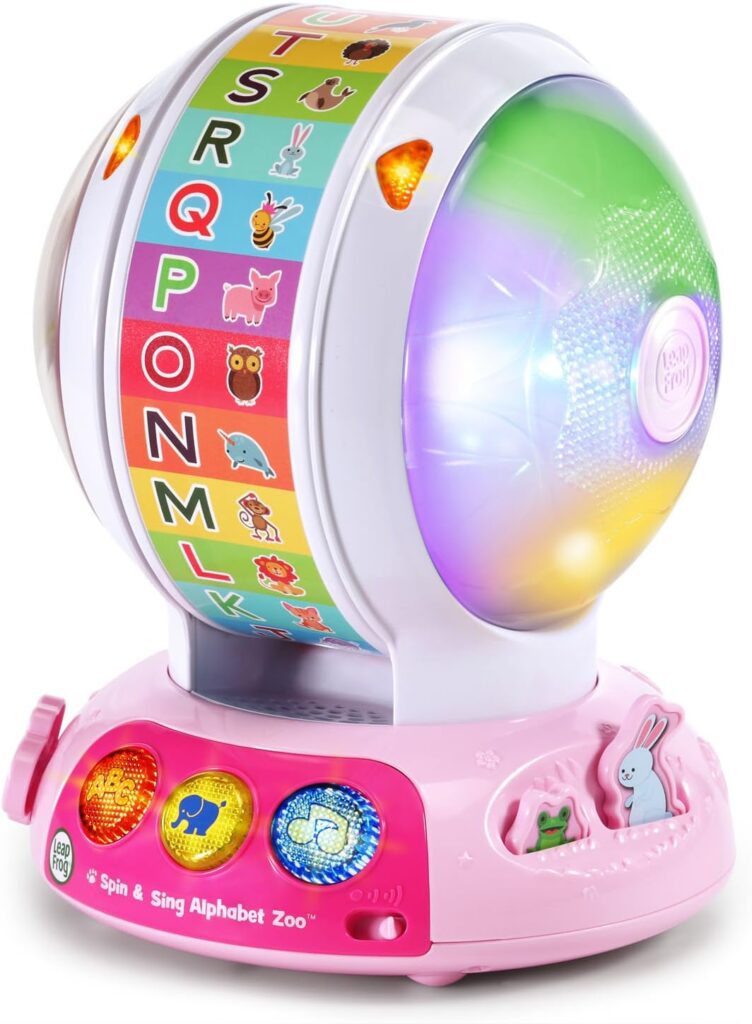


LeapFrog Spin and Sing Alphabet Zoo, Pink: A Hands-On Introduction to Letters and Animals
Toys that ask a young child to do something—press, spin, slide, push—tend to hold attention longer than toys that simply play at them. The LeapFrog Spin and Sing Alphabet Zoo in pink is built around that idea. It is an interactive spinning toy that combines an alphabet and animal theme with three distinct modes of play, and it gives small hands plenty of ways to make something happen. Rather than presenting letters as a static display, it ties them to animals, sounds, music, and light, so each interaction produces a response.
This review looks at what the toy actually offers, how its features fit together, and which families may find it a good match for their child’s stage of development.
Design and Build Quality
The Alphabet Zoo is a ball-shaped toy, and its form is central to how it works. The design places an inner wheel at the center, and every spin of that wheel turns the mechanism inside. On one side, the spin triggers spinning balls; on the other, it projects LED colors through a pattern of different shapes. That dual-sided response means the toy reacts visually in more than one way as a child turns the wheel.
Around the body of the toy, LeapFrog has placed a set of physical controls: three light-up buttons, a sliding bee, and a frog and rabbit button. These are not decorative. Each one is part of the play loop, and together they give a child several different hand movements to practice. The pink colorway is the version described here; the toy’s core features are tied to its design rather than its color.
Features and Technology
The headline feature is the three-mode play system. The toy offers a letter mode, an animal mode, and a music mode, and each mode changes what the child hears when they interact with it.
- Letter mode: Pressing the light-up buttons introduces letter names, supporting the toy’s stated goal of introducing letters A–Z.
- Animal mode: The same buttons introduce animal names and animal sounds, tying each letter to a creature.
- Music mode: The toy plays musical responses, including the ABC song and a song about colors and shapes, which children can sing along to.
The spinning wheel is the thread that connects these modes. When the wheel stops, the toy responds with either letter names or animal names and sounds, depending on the mode in use. That stop-and-respond pattern is a simple but effective feedback loop: the child’s action produces an immediate, relevant result.
The light-up buttons and the LED color projection add a visual layer to the audio responses. LeapFrog describes these as playful musical responses and lights that reward each touch, which frames the lights as part of the encouragement structure rather than as a separate feature.
Performance and Everyday Experience
In day-to-day use, the Alphabet Zoo is a toy that asks for active participation. A child does not simply watch it; they spin the wheel, press the three buttons, slide the bee, and push the frog and rabbit buttons. Each of those actions is a small motor task, and LeapFrog explicitly states that spinning, pushing, and sliding are intended to help develop motor skills. That makes the toy as much a physical activity as a learning one.
The multi-sensory approach is worth noting. A child hears letter names or animal sounds, sees lights and projected shapes, and feels the wheel turn under their hand. For a young learner, that combination can reinforce the connection between a letter, an animal, and a sound in a way that a single-sense toy cannot. The ABC song and the colors-and-shapes song add a musical route into the same material, giving children a way to engage through singing as well as through pressing and spinning.
The three-mode structure also means the toy can grow with a child’s interests to some degree. A child who is first exploring animal sounds can stay in animal mode, while one who is starting to recognize letters can move to letter mode. The modes are selectable, so the same toy can serve different stages without requiring a new purchase.
Learning Content and Interaction
The educational scope is clearly defined: the toy introduces letters A–Z along with animal names and sounds. It does not claim to teach reading or writing, and it should be understood as an introduction rather than a curriculum. Its value lies in familiarization—repeated exposure to letter names and animal vocabulary through play.
The interaction model is equally clear. Every spin turns the inner wheel and triggers the spinning balls and the LED projection. When the wheel comes to rest, the toy delivers its letter or animal response. The buttons, the sliding bee, and the frog and rabbit buttons provide additional touchpoints, each producing a reaction. That consistency—action followed by response—is what makes the toy feel responsive rather than passive.
Who Is This Product Best For?
Based on the stated features, the Alphabet Zoo suits families with young children who are beginning to explore letters and animals and who enjoy hands-on play. The combination of pressing, spinning, sliding, and pushing makes it a reasonable fit for children who like to keep their hands busy, and the stated motor-skill focus supports that use.
It is also a sensible option for parents looking for a toy that blends early letter recognition with animal vocabulary and music, rather than focusing on just one. The sing-along element may appeal to children who respond well to songs, while the light-up buttons and LED projection offer visual feedback for those who are drawn to cause-and-effect play. Because the toy is described as introducing letters A–Z, it is positioned at the introductory stage rather than for children already confident with the alphabet.
Final Verdict
The LeapFrog Spin and Sing Alphabet Zoo is a thoughtfully layered interactive toy. Its three play modes—letters, animals, and music—are tied together by a spinning wheel that responds when it stops, and its buttons, sliding bee, and animal buttons give children multiple ways to engage. The stated goals of introducing letters A–Z and animal names and sounds, along with supporting motor-skill development through spinning, pushing, and sliding, are consistent with how the toy is built.
It is not a complex device, and it does not pretend to be. Its strengths lie in its clarity: every action has a response, every mode has a purpose, and the learning content is well defined. For families seeking an engaging, hands-on introduction to letters and animals for a young child, the Alphabet Zoo in pink is a coherent and well-organized choice.