
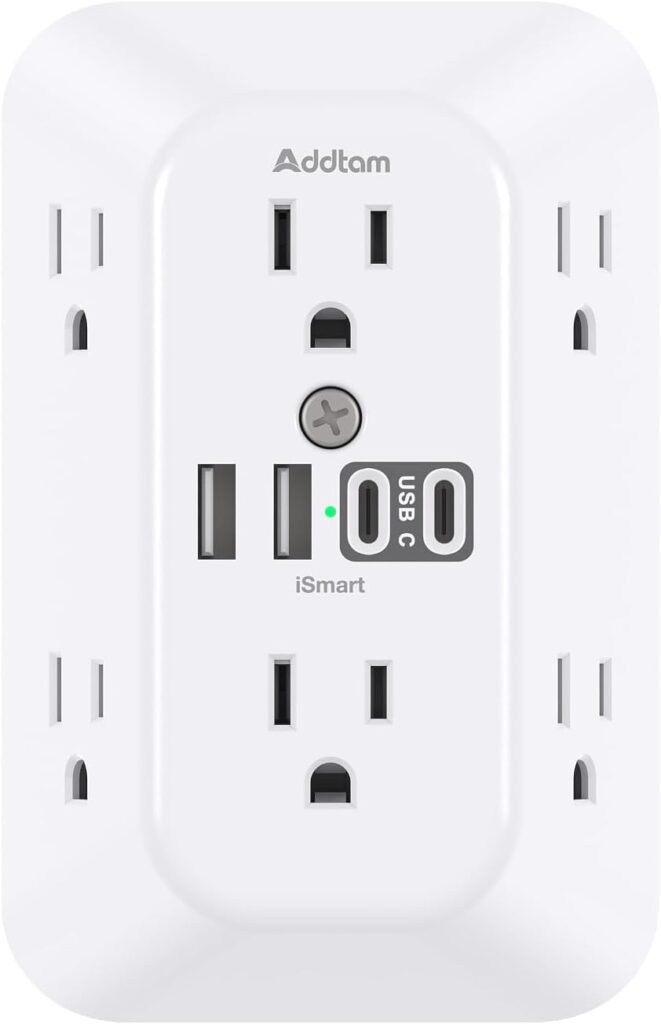


Addtam Surge Protector Outlet Extender with 6 AC and 4 USB Ports (2 USB C)
Wall space is often the scarcest resource in a room. A standard duplex outlet offers two receptacles, and once a lamp and a phone charger claim them, everything else has to wait its turn. The Addtam Surge Protector Outlet Extender takes a different approach: instead of a power strip with a cord, it plugs directly into an existing wall outlet and multiplies what that single point can do. The unit combines six AC outlets with four USB ports, two of them USB-C, for a total of ten charging points from one wall position. It is a compact, screw-secured outlet extender aimed at anyone who needs more plugs without adding another corded strip to the floor.
Design and Build
The extender is built around a plug-in format that fits a duplex outlet, with the company stating it seats onto the outlet directly. The housing is made of fire-resistant ABS, which the manufacturer describes as rated to 1382°F. That material choice is a stated product characteristic rather than an independently verified result, but it is worth noting because outlet extenders sit against the wall and handle continuous loads.
Two design details separate this unit from simpler splitters. The first is a screw at the middle of the faceplate, and the package includes the hardware needed to secure the extender to a duplex outlet. The stated purpose is practical: with the screw in place, pulling a plug out of the extender is less likely to drag the whole unit away from the wall. The second is a plastic prong on the back that provides reinforcement. That prong is not universal, however. The manufacturer notes it must be cut off before the extender is used with a USB receptacle or a GFCI outlet, so buyers with those outlet types should plan for that step.
Physical dimensions are listed at 5.4 by 3.5 by 1.8 inches, which keeps the footprint close to the wall rather than projecting far into the room.
Features and Technology
The headline number is the surge rating: 1800 joules. Addtam describes the protection circuit as a three-level complementary design built from TVS, MOV, and GDT components, and states that this arrangement can respond to surges more quickly than a single-level MOV circuit. That is the manufacturer’s claim about its own design, and it is the kind of specification worth understanding rather than simply comparing numerically. Alongside surge protection, the listing states the unit includes overload protection, short-circuit protection, over-current protection, over-voltage protection, and overheating protection.
The AC side carries a 125V/15A/1875W rating, which is the standard household circuit range in the United States. The six outlets are spaced 2.2 inches apart, compared with the roughly 1.5-inch spacing common on standard sockets. That extra room matters in practice: bulky adapters and transformer-style plugs often block neighboring outlets on a conventional strip, and wider spacing reduces that overlap.
The USB section consists of two USB-A ports and two USB-C ports. Each USB-A port is rated for 5V/2.4A maximum output, and each USB-C port for 5V/3A maximum. The unit includes smart detection technology that the company says identifies connected devices and adjusts charging speed automatically, with stated compatibility for Kindle and most USB devices. One limitation deserves emphasis: the USB-C port is not Quick Charge 3.0 and does not support devices that require 9–22V charging voltage. Anyone expecting fast-charge performance from a USB-C power adapter should treat this extender as a standard 5V charging source instead.
Performance and Everyday Experience
The practical value of a ten-in-one extender shows up in how a desk or bedside area actually gets used. A monitor, a lamp, a laptop power supply, and a couple of small electronics can all share the six AC outlets, while phones, earbuds, and a tablet draw from the USB ports without consuming any of those AC spaces. Because the USB ports deliver power directly, the usual tangle of charging bricks shrinks, and the wide outlet spacing means larger adapters are less likely to crowd each other out.
The screw-in mounting is the detail that most affects daily use. An extender that hangs only on the outlet prongs can work loose over time, particularly when devices are unplugged frequently. Securing it with the included screw addresses that specific annoyance, and the reinforcement prong adds stability on compatible outlets. The trade-off is a small amount of setup: the prong must be removed for USB receptacles and GFCI outlets, and the screw needs to be fitted to the wall plate. Neither step is complicated, but both are worth knowing before installation.
Because the unit plugs directly into the wall, it does not introduce a cord to route or trip over, which suits rooms where floor space or cable management is tight. It also means the extender’s position is fixed to the outlet rather than movable like a corded strip, so placement should be chosen with that in mind.
Compatibility and Charging Notes
The extender is designed for duplex outlets and decor outlets, and the manufacturer lists travel, college dorm rooms, home, office, bedroom, and kitchen among intended settings. The 125V/15A/1875W rating aligns with typical North American household circuits. On the USB side, the 5V output ceiling is the key compatibility boundary: standard USB devices are supported, but hardware that depends on higher-voltage fast charging will not get it here. The unit is certified by ETL, and Addtam states a 30-day return window, a 12-month replacement period, and 24-hour customer service support.
Who Is This Product Best For?
This outlet extender suits anyone whose wall outlet is outnumbered by their devices. Students setting up a dorm room, remote workers building a desk station, and households that want to consolidate phone and tablet charging into one wall point are all reasonable fits given the stated use cases. It is also a sensible option for older homes or apartments where adding circuits is impractical and the goal is simply to use an existing outlet more efficiently. Buyers who specifically need USB-C Power Delivery or other high-voltage fast charging should look elsewhere, since the manufacturer explicitly states that support is absent.
Final Verdict
The Addtam Surge Protector Outlet Extender earns its place through consolidation rather than novelty. Six widely spaced AC outlets, four USB ports with smart detection, 1800 joules of stated surge protection, and a screw-secured mounting system cover the core needs of a busy wall outlet without adding a corded strip to the room. The limitations are clearly disclosed: the USB-C ports are 5V only, and the reinforcement prong requires modification for USB receptacles and GFCI outlets. For buyers who understand those boundaries and mainly need more outlets and standard USB charging in one compact wall-mounted unit, this is a well-considered option.

