
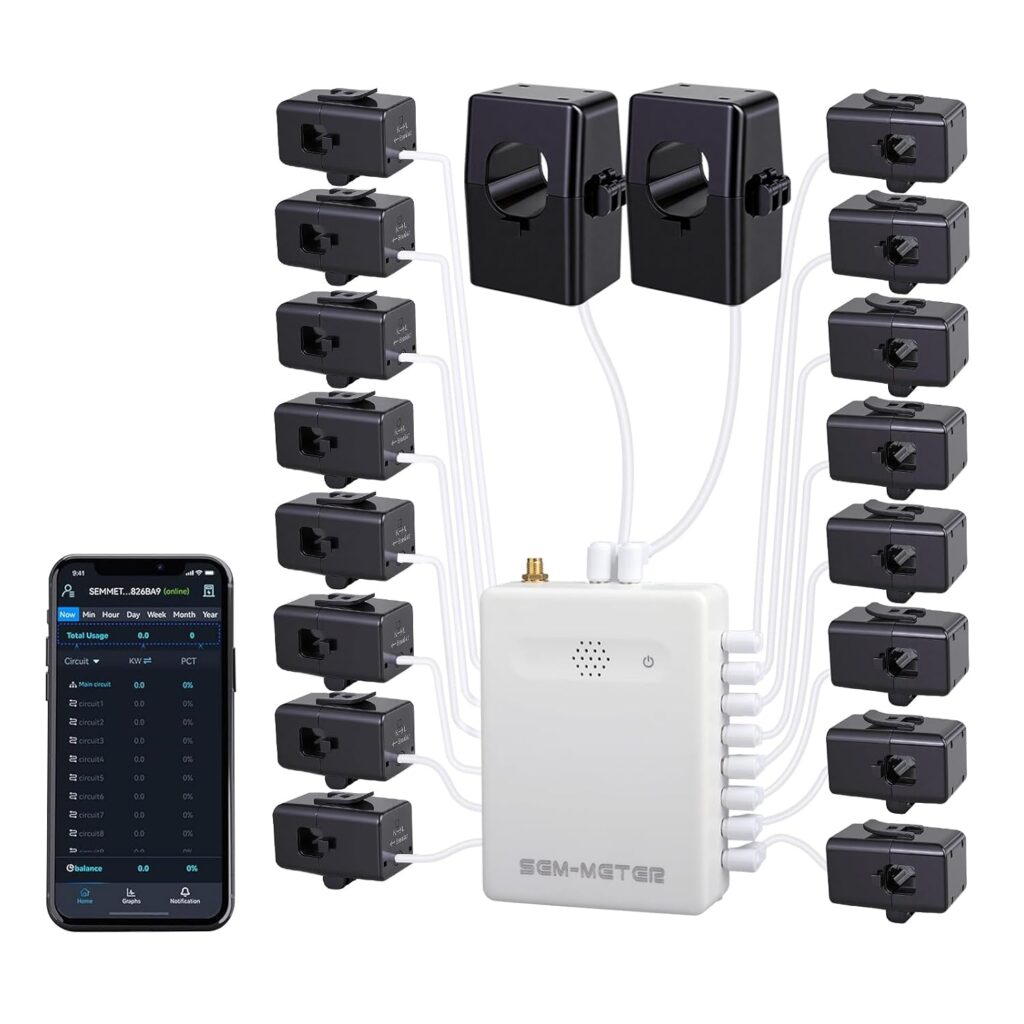


Smart Home Energy Monitor with 16 50A Circuit Level Sensors: A Closer Look
Whole-home energy monitoring has traditionally meant watching a single number go up and down without much idea of what is driving it. The SEM-Meter smart home energy monitor takes a different approach. Rather than measuring only total consumption at the main feed, it ships with sixteen 50A clamp-on sensors intended to track individual branch circuits, so the electricity used by specific appliances and areas can be separated out. Combined with real-time reporting, tariff-based cost calculations, and an unusually privacy-focused operating mode, it is aimed at homeowners and property managers who want granular insight rather than a single aggregate figure.
Design and Installation Approach
The core of the system is a monitor that installs inside the circuit panel using clamp-on sensors. According to the manufacturer, it supports single-phase systems up to 240VAC line-neutral, single and split-phase 120/240VAC configurations, and three-phase systems up to 415Y/240VAC. One important limitation is stated clearly: Delta configurations are not supported. The branch lines are described as able to automatically match different phases, with no restrictions on the quantity or voltage of those lines, which suggests flexibility when mapping circuits inside a compatible panel.
Installation is described as suitable for most homes, but there is a caveat worth noting. Panels where only the busbars are accessible will require flexible sensors, which the manufacturer says are available separately from SEM-Meter. In other words, the standard clamp-on sensors cover many common setups, but not every panel layout, and buyers should confirm their panel type before committing. Because the work happens inside an electrical panel, this is the kind of installation that many households will want handled by a qualified electrician.
Features and Monitoring Capabilities
The sixteen included 50A sensors are the headline feature. They are intended to monitor specific electrical appliances such as air conditioners, furnaces, water heaters, washers, dryers, and ranges. In practical terms, that means the system can break consumption down by circuit rather than lumping everything together, which is the foundation for understanding where electricity is actually going.
The monitor connects over 2.4GHz WiFi and reports an accuracy range of 1%. Usage can be viewed in real time through Android and Apple software, with statistics organized by now, day, week, month, and year. Data export is also part of the package: hourly exported data is stated to remain valid for 90 days, while day, month, and year exports are described as permanent and available at any time from the application. For anyone who likes to keep records or analyze trends in a spreadsheet, that export capability is a meaningful addition.
Beyond raw consumption, the system is designed to measure real-time spending and to deliver actionable notifications intended to help users identify where savings can be made. The manufacturer frames this around lowering electric bills, conserving energy, and reducing environmental impact. Those are stated aims rather than guaranteed outcomes, since actual savings depend on how the information is used.
Privacy Mode and Local Control
One of the more distinctive aspects of this monitor is what the manufacturer calls Super Privacy Mode. In this configuration, the device can run without the company’s cloud and without its app, using only a user-supplied MQTT server. It can operate on a local network without internet access, with Home Assistant and MQTT required for that setup. For households that prefer to keep energy data entirely on their own infrastructure, this is a notable option, though it does assume some familiarity with MQTT and Home Assistant. Users who want the simplest path will likely stay with the standard app-based experience.
Performance and Everyday Experience
In daily use, the value of a circuit-level monitor comes from context. A whole-home figure tells you that consumption is high; sixteen branch sensors can help show whether the air conditioner, the water heater, or the dryer is responsible. The real-time view and the now/day/week/month/year breakdowns support that kind of investigation, and the 1% stated accuracy range suggests the readings are intended to be dependable for this purpose. The notification system adds a layer of ongoing awareness, flagging spending as it happens rather than only after the fact.
It is worth being clear about what the supplied information does and does not establish. The manufacturer describes accuracy, supported configurations, and data retention, but independent performance in any particular home will depend on panel type, sensor placement, and how circuits are mapped. The system is also explicitly not compatible with Delta three-phase setups, and panels with only busbar access need different sensors. These are practical constraints rather than flaws, but they matter when assessing fit.
Billing Allocation for Rental Properties
A less common but potentially useful application is electricity bill allocation. The monitor is described as suited to rental houses, shared apartments, and multi-room properties. Because multiple circuits can be tracked, usage for each bedroom, common area, or EV charger can be followed without installing separate electricity meters. The system supports customizable rate templates, including peak, off-peak, and holiday pricing, allowing automatic cost calculation based on time-of-use tariffs. Once a template is set, landlords or property managers can see usage and cost per room or circuit, which the manufacturer presents as a way to make billing transparent and allocation fairer. This is a specific, well-defined use case rather than a general claim, and it rests on the circuit-level monitoring the hardware provides.
Who Is This Product Best For?
Based on the stated features, this monitor suits several groups. Homeowners with compatible panels who want to understand appliance-level consumption and act on real-time spending data are the most obvious audience. Technically inclined users who run Home Assistant and an MQTT server will find the local, cloud-free privacy mode appealing. Landlords and property managers overseeing shared or multi-room properties have a clear use case in per-circuit cost allocation with time-of-use rate templates. Finally, households monitoring solar or net metering are explicitly mentioned as a supported scenario. Buyers should first confirm their panel configuration, since Delta three-phase systems are excluded and busbar-only panels require separate flexible sensors.
Final Verdict
The SEM-Meter smart home energy monitor is a purpose-built device for granular electricity insight. Its sixteen 50A sensors, broad phase support, real-time app reporting, exportable statistics, tariff-based cost calculation, and optional local-only operation via MQTT give it a feature set that goes well beyond a basic whole-home meter. The stated 1% accuracy range and one-year warranty round out the package. The main considerations are practical: panel compatibility, the exclusion of Delta configurations, the need for separate sensors in some panels, and the technical know-how required for the privacy mode. For users whose setup fits within those boundaries and who want circuit-level visibility rather than a single consumption figure, it addresses a genuine gap in home energy monitoring.