

Wooden Montessori 3 in 1 Learning Fine Motor Preschool Toys for 1-3
Montessori-inspired toys tend to earn their place in a playroom not because they do a single thing well, but because they invite a child to return to them in different ways as their abilities grow. The Wooden Montessori 3 in 1 Learning Fine Motor Preschool Toys for 1-3, from the SMALL FISH brand, is built around exactly that idea. Rather than offering one activity, it packages several related hand-skill exercises into a single wooden set, with a canvas bag that makes the whole thing portable. This review walks through what the set includes, how the pieces are meant to be used, and which children are most likely to get something out of it.
Design and Build Quality
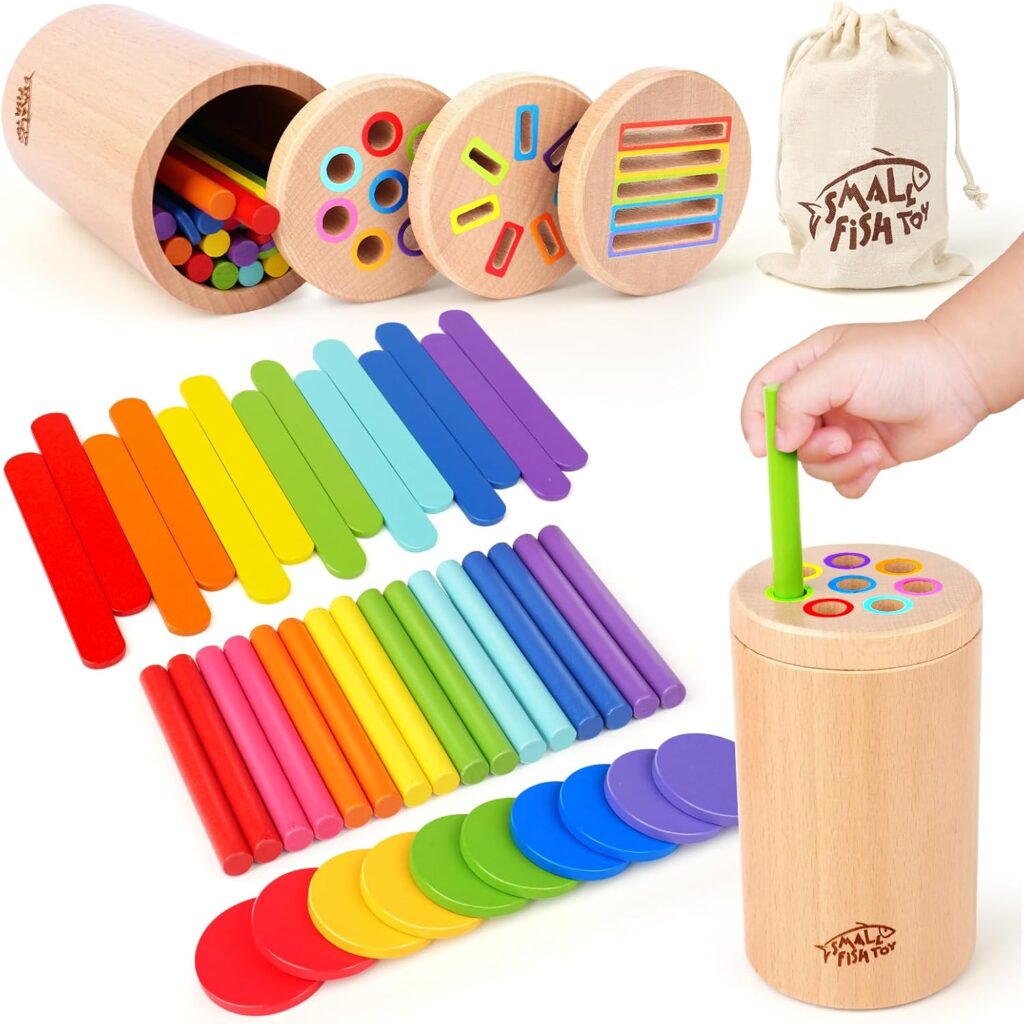
The core of the set is a wooden tube paired with three interchangeable lids, each offering a different way for a child to interact with the pieces. The wood used is natural beech, which the brand states is sourced from Romania and Germany. According to the product information, the wood goes through a hollowing and fine polishing process, and the surface is finished with a food-grade safety coating. The set is also described as using edible children’s paint that is bright in color and not easy to fade.
One detail worth noting is sizing. The toys are stated to be in international Montessori sizes, described as suited to little hands while still being thick enough to handle. That combination matters for this age group, since pieces that are too thin can be difficult for small fingers to grip, while pieces that are too bulky can be frustrating to manipulate. The brand also states that the wood craftsmanship is reliable enough to withstand active play by young children, which is a stated product claim rather than an independently verified one.
Features and Technology
The “3 in 1” label refers to the three distinct activities the set supports, all centered on the wooden tube and its lids. The first involves inserting colored wooden sticks into holes, an activity the brand describes as exercising fine motor skills and color recognition. The second uses popsicle sticks, which require a child to rotate their wrist and find the right angle to enter a slit. That rotational movement is presented as helping develop a sense of direction. The third activity involves delivering coins, described as an early lesson in saving, with coin stacking offered as an additional exercise.
In total, the package includes 16 colorful sticks, 14 popsicle sticks, and 10 discs. The brand frames this combination as a classic early-education gift package. Beyond the physical pieces, the set is intended to support color cognition, spatial concepts, imagination, and innovation, along with fine movement control and directional awareness. The separate lid is designed for a child to open by hand, which the brand connects to learning to store items and to the concept of object permanence.
Performance and Everyday Experience
What stands out about this set is how the difficulty scales across the three activities without requiring separate purchases. Inserting sticks into holes is a relatively straightforward task, while the popsicle stick slit demands more precise wrist control, and the coin delivery adds a different kind of hand movement. For a child moving through the 1-to-3 range, that progression means the toy can stay relevant as their coordination develops, rather than being outgrown quickly.
The open-ended nature of the pieces also matters. Because the lids are interchangeable and the parts can be combined as the child likes, play does not have to follow a fixed sequence. A parent or caregiver can set out just the sticks and the hole lid for a younger toddler, then introduce the popsicle sticks and slit later. The brand notes that the child can organize the toys and place them into the canvas bag independently, which turns cleanup into part of the activity rather than a separate chore. Cleaning the pieces themselves is described as simply requiring a wipe.
Portability and Storage
The included canvas drawstring bag is a practical addition rather than an afterthought. Because the set breaks down into loose pieces, the bag gives everything a single home, and the brand specifically mentions carrying it to church or a restaurant, to class, or in the car. For families who need a quiet, screen-free activity that travels well, that portability is a meaningful part of the package. The drawstring design also means a child can open and close the bag themselves, which aligns with the broader emphasis on independent handling throughout the set.
Who Is This Product Best For?
This set is aimed at children roughly between one and three years old, which matches the activities described. It is likely to appeal to parents and caregivers specifically looking for Montessori-style materials that focus on fine motor development, color recognition, and directional awareness rather than electronic sounds or lights. The combination of a wooden tube, multiple lids, and a large count of small pieces makes it a good fit for families who want a single set that covers several skill levels.
Because the brand presents it as a gift option, it is also positioned for occasions such as a birth gift for a new mom, Children’s Day, birthdays, Christmas, stocking stuffers, or Easter. Grandparents, teachers, and anyone shopping for a toddler in that age band may find it a reasonable choice, particularly if they want something that encourages hands-on exploration and can be stored and carried easily.
Final Verdict
The Wooden Montessori 3 in 1 Learning Fine Motor Preschool Toys for 1-3 is a thoughtfully assembled early-learning set. Its strengths lie in the variety of hand activities it supports, the interchangeable lid design that lets play adapt to a child’s stage, and the natural beech wood construction with a food-grade coating and edible paint finish as stated by the brand. The inclusion of 16 colorful sticks, 14 popsicle sticks, 10 discs, and a canvas drawstring bag rounds out a package that is easy to store and take along.
It is not a toy that does the entertaining for you. The value comes from a child’s repeated attempts at inserting, rotating, and stacking, which is precisely the kind of repetition that supports fine motor development. For families seeking a portable, open-ended Montessori-style activity for a toddler in the one-to-three range, this set covers a lot of ground within a single purchase. Those looking for a screen-free, hands-on option with room to grow will find it a sensible addition to the toy rotation.