

HomeTrack Home Gym Review: Seated Exercise for Circulation, Balance, and Core Strength
Staying active when movement is limited is one of the more difficult challenges in everyday fitness. The HomeTrack Home Gym approaches that problem from a different angle: instead of asking you to stand, jump, or pivot, it is built around exercise performed entirely from a seated position. The system combines upper and lower body movement in a single unit, using low-impact resistance bands and tri-directional foot pedals. For anyone who wants to keep muscles engaged without loading the joints, that design premise is the central appeal.
This review walks through what the HomeTrack Home Gym actually is, how its components are arranged, and what the stated features mean in practical use. It is aimed at readers who want a clear picture of the product before deciding whether a seated exerciser fits their routine.
Design and Build Quality
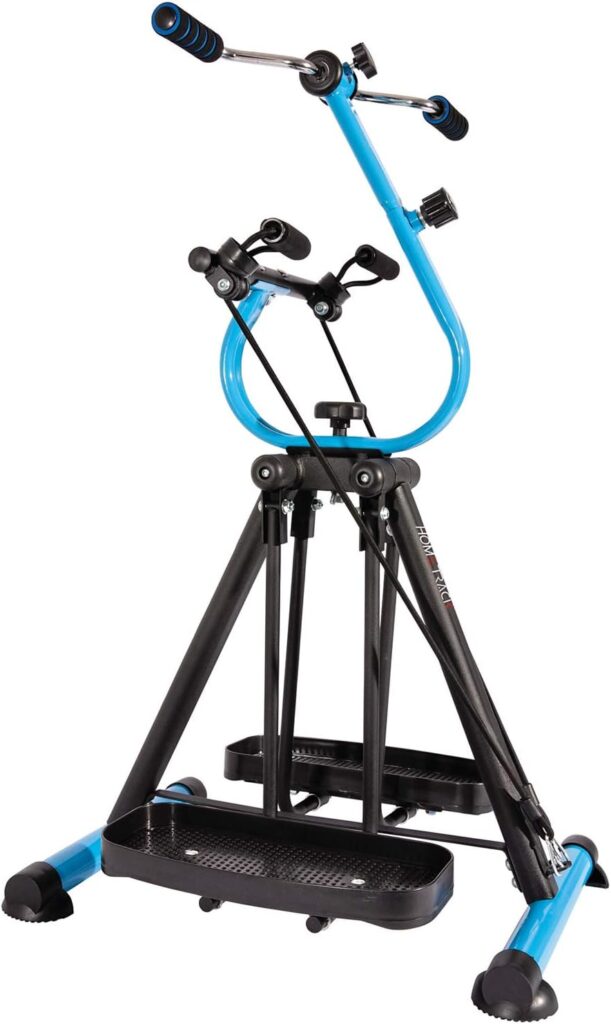
The HomeTrack Home Gym is described as an all-in-one system with a sturdy steel frame and plastic components. It is an imported product with a listed model number of ZB8339. The manufacturer is North American Health + Wellness, and the unit measures 22 inches long, 15 inches wide, and 35 inches high, with a separate product dimension listing of 22.5 x 17 x 5.5 inches and a weight of 21.85 pounds. Those two sets of dimensions appear in the supplied information, and the difference suggests one may refer to the assembled unit while the other reflects packaging or a collapsed state; the source does not clarify which is which.
Assembly is described as easy, though no tools, steps, or time estimates are provided. The footprint is relatively compact for a home gym system, which matters if the unit will live in a living room, bedroom, or beside a favorite chair rather than in a dedicated workout space. The steel frame is the load-bearing structure, while the plastic elements cover the pedals, handles, and housing. Because the source does not specify frame thickness, coating, or component tolerances, no claims about long-term durability can reasonably be made here.
Features and Technology
The defining feature of this seated manual home gym is its dual-action layout. The lower half uses tri-directional foot pedals, which the listing states support ankle, knee, and lower body workouts. The upper half uses low-impact resistance bands, along with two-directional handles, to help tone the arms and upper body. Together, these elements are intended to deliver what the product describes as a complete cardio workout from the comfort of a favorite chair.
One detail worth highlighting is the resistance control arrangement. The steel frame has separate resistance controls for the hand and foot pedals, which means the upper and lower sections can be adjusted independently. In practice, that allows a user to set a lighter resistance for the arms while keeping more tension in the pedals, or the reverse. It is a meaningful design choice for anyone whose upper and lower body strength differ, or for those who want to progress one area faster than another.
The system is manual rather than motorized, so the pace and effort come from the user. The listing emphasizes low-impact movement throughout: no jumping, no pivoting, and what it describes as ultra-low exertion for toning the hamstrings, quadriceps, biceps, and triceps. These are stated product claims rather than independently verified results, and they should be read as the manufacturer’s description of intended use.
Performance and Everyday Experience
The HomeTrack Home Gym is positioned around a simple idea: exercise that fits into whatever time you have free, done whenever you would like. Because it is used while seated, it does not require changing clothes, clearing floor space, or committing to a full workout session. That lowers the barrier to using it, and the listing explicitly suggests that a comfortable workout is one you will most likely use more often.
The tri-directional pedals are the core of the lower body experience. Rather than a single forward-pedaling motion, the design supports movement in three directions, which the source links to ankle, knee, and lower body work. For anyone dealing with bone or joint conditions, or recovering from an injury, that variety may be relevant because it changes the angle of movement rather than repeating one motion. The listing specifically names people recovering from injury and those with bone or joint conditions as groups this seated pedaler is ideal for.
On the upper body side, the resistance bands and two-directional handles are intended to tone the arms without strain. The phrase “low-impact” appears repeatedly in the product information, and the overall framing is one of maintaining muscle tone without stressing weight-bearing joints. The unit is also described as helping improve circulation, balance, and core strength, which reflects the manufacturer’s stated purpose for the system rather than a measured outcome.
Who Is This Product Best For?
Based on the supplied information, the HomeTrack Home Gym is aimed at a fairly specific audience. The listing states it is ideal for everyone, and then narrows that with particular emphasis on people recovering from injury or managing bone and joint conditions. The seated format, low-impact bands, and absence of jumping or pivoting all point in the same direction.
- People who want to exercise while seated rather than standing or moving around a room.
- Individuals recovering from injury who need to avoid strain on weight-bearing joints.
- Those managing bone or joint conditions who still want to maintain muscle tone.
- Anyone looking for a low-impact way to work arms, legs, and core in one unit.
- Users who prefer short, flexible sessions fitted around free time rather than scheduled workouts.
It is less obviously suited to anyone seeking high-intensity training, heavy resistance work, or a machine that simulates running or cycling at speed. The design is built around gentle, controlled movement, and the source makes no claims beyond that scope.
Final Verdict
The HomeTrack Home Gym is a seated, manual exercise system that combines tri-directional foot pedals with low-impact resistance bands and two-directional handles. Its steel frame, separate resistance controls for hands and feet, and roughly 22 by 15 by 35 inch footprint give it a defined place in a home. The stated purpose is to support circulation, balance, and core strength while toning the arms, legs, and torso without strain on weight-bearing joints.
What stands out is the independence of the upper and lower sections. Being able to adjust hand and foot resistance separately is a practical advantage for anyone whose strength is uneven between the two, and it makes the unit more adaptable than a single-resistance design would be. The seated format and the emphasis on no jumping or pivoting align with the recovery and joint-condition use cases the listing names.
The limitations are equally clear. This is a low-impact, manual exerciser, not a replacement for a full strength or cardio program, and the source does not provide details on resistance levels, assembly time, or warranty coverage. Anyone expecting measurable performance data or a wide range of resistance settings will not find that information here. For its intended audience, however, the HomeTrack Home Gym presents a coherent, purpose-built option: a way to keep the body moving from a chair, at whatever pace and time suits the user.