





Alarm System for Home Security (24-Piece): A DIY Wireless Security Setup
Home security systems have traditionally meant professional installation, long-term contracts, and recurring monitoring charges. The Alarm System for Home Security (24-Piece) takes a different approach. It is a wireless, do-it-yourself kit built around a touchscreen control panel, a collection of sensors and accessories, and app-based control through the Smart Life or Tuya ecosystem. The stated pitch is straightforward: one system, no monthly fees, and a setup process designed to be handled by the homeowner rather than a technician.
This review walks through what the kit includes, how the components are meant to work together, and where the practical considerations lie — particularly around connectivity, since that is where this type of product tends to live or die.
Design & Build Quality
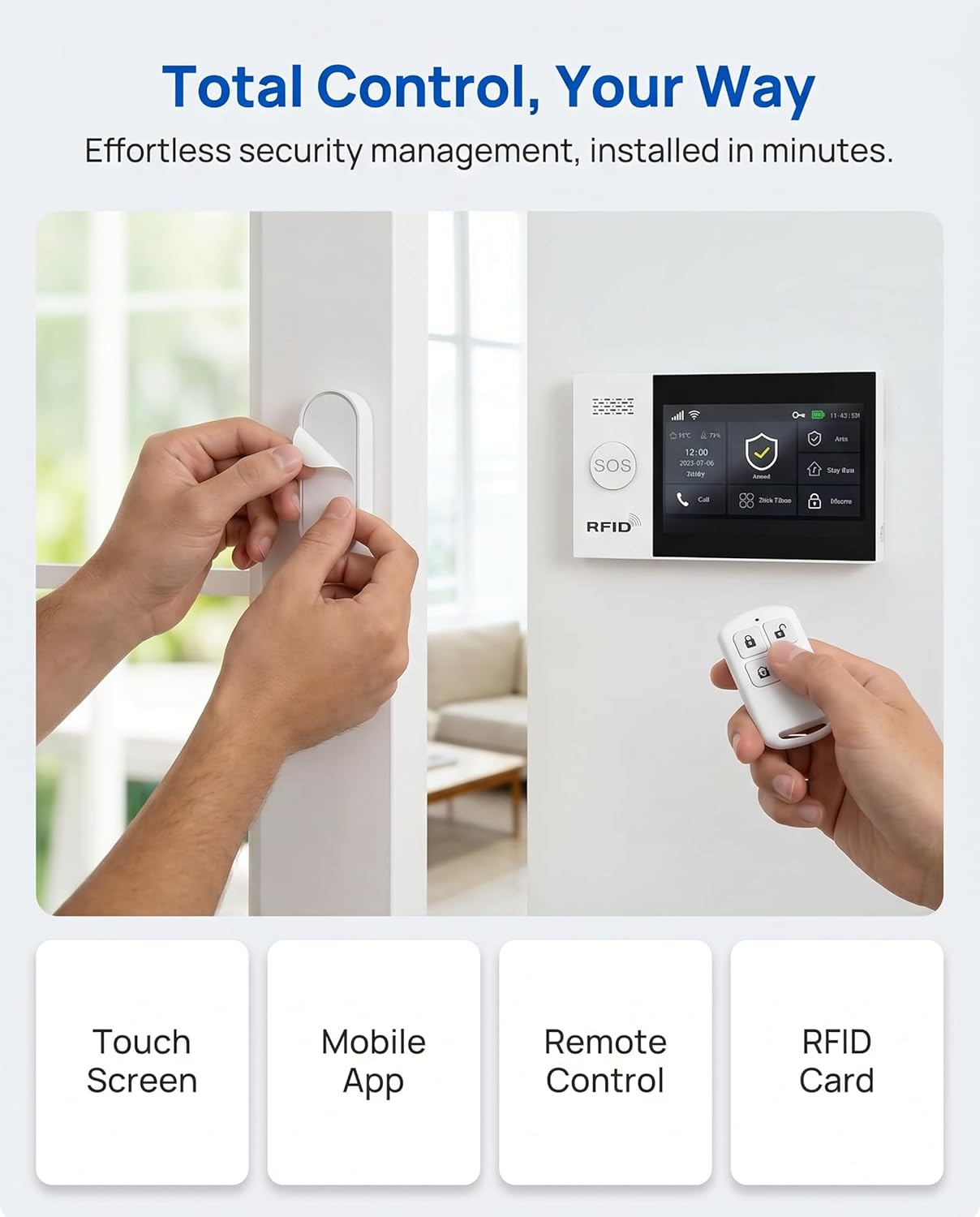
The centerpiece of the kit is a base station with a 4.3-inch color touchscreen. That screen is not just decorative: it displays system status, the time, and alerts, and it provides tap controls for arming and disarming. The stated intent behind the touchscreen interface is accessibility — a multi-language menu designed to be usable by children and seniors, not only by people comfortable with technical setup.
Language support is unusually broad for this category. The menu is stated to cover English, Chinese, German, French, Spanish, Italian, Portuguese, Polish, Greek, and more. For multilingual households, or for aging parents who may be more comfortable navigating a system in their first language, that is a meaningful design decision rather than a spec-sheet afterthought.
Physical controls extend beyond the screen. There is an SOS button on the base station itself, and the kit also includes a remote and a dedicated SOS button accessory. The 24-piece configuration bundles the panel together with siren, remote, sensors, and an RFID card, so the core hardware arrives in one package rather than requiring separate purchases.
Features & Technology
The system is built around wireless sensors. According to the supplied information, it can connect up to 100 devices — door and window contacts, motion sensors, and similar accessories — all managed through a single app. That ceiling matters for larger homes or small businesses where coverage needs to extend across multiple rooms, entries, and outbuildings.
Range is stated at up to 393 feet (roughly 120 meters) between a sensor and the alarm panel base station. The manufacturer notes that sensors should be installed within that distance for optimal detection performance. In practice, that figure gives reasonable flexibility for placing sensors across a typical house, though walls and layout will naturally affect any wireless signal.
Accessories arrive factory-pre-paired. The stated setup sequence is a three-step process covering the menu, the parts, and the sensors — no manual pairing of each individual device. That removes one of the more tedious steps in DIY alarm installation, where each sensor normally has to be introduced to the hub one at a time.
Family access is handled through the app, with the ability to share access so multiple household members can arm, disarm, and monitor alerts. The system is also described as supporting motion and door-triggered push alerts or phone calls.
Connectivity & App Control
This is the section worth reading carefully, because the connectivity model is more layered than the marketing language might suggest.
The system supports dual connectivity: 2.4GHz Wi-Fi and 2G/4G cellular. Notably, 5GHz Wi-Fi is not supported, so the panel needs to be on a 2.4GHz network. The cellular side requires a GSM card, which is sold separately.
The supplied information is explicit about the limits here. Without a SIM card, the product cannot receive calls. Without a SIM card and an active network connection, the product will not be able to work. However, notifications can still be received through the Smart Life app over Wi-Fi. So the practical picture is this: Wi-Fi alone can support app-based alerts, while the SIM card path adds SMS and voice call notifications — and is what keeps the system communicating if the home network goes down.
Control runs through the Smart Life/Tuya app, which turns a phone into a monitoring interface for the system. That is the same app ecosystem used by a wide range of smart home devices, so anyone already running Tuya-compatible products will find the interface familiar.
Power & Backup
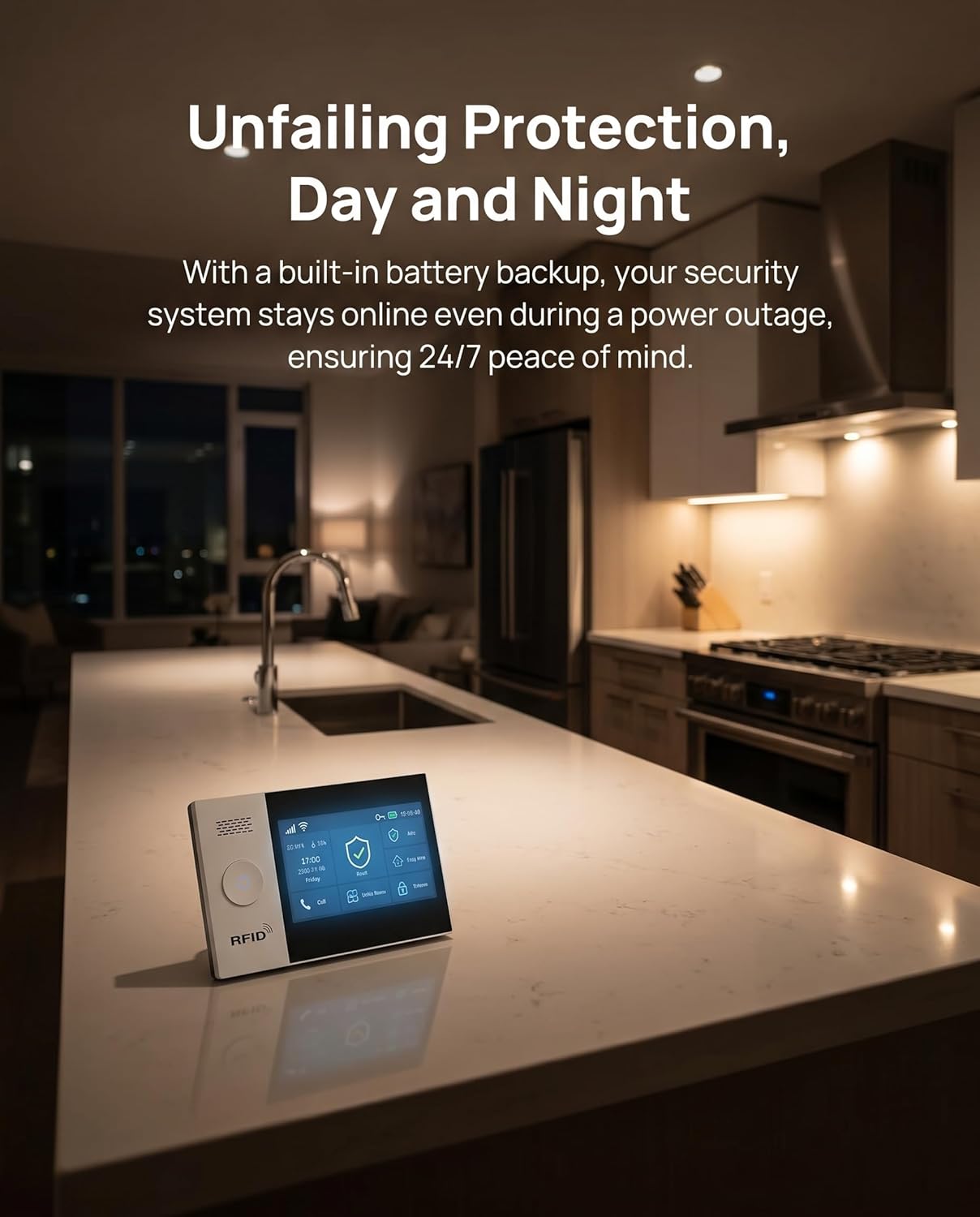
For daily operation, the alarm panel needs to be plugged into a power outlet for charging. That is worth noting up front, since it means the base station is not a purely battery-operated device.
There is a backup battery for outages. The stated runtime is 4 to 8 hours during a power failure. That window is enough to cover most short interruptions, though the range itself suggests it varies depending on conditions. The system is also described as functioning without power concerns in the sense that the backup keeps it running temporarily — not indefinitely.
Arming Modes and Sensor Placement
The supplied information includes a somewhat unusual note on arming modes that deserves attention, because the wording is counterintuitive.
According to the product information, when at home you would use Away Arming to detect outdoor intrusions, with compatible sensors installed indoors. When away, you would use Home Arming to protect indoor property, with compatible sensors installed outdoors. This is the reverse of how these mode names are typically used in the security industry, so buyers should follow the manufacturer’s stated guidance rather than assumptions based on the labels. It is a detail worth confirming during setup.
Who Is This Product Best For?
Based on the stated features and use cases, this kit suits a few specific situations.
- DIY installers: Factory-pre-paired accessories and an app-driven setup process are aimed at people who want to avoid professional installation.
- Multilingual and multi-generational households: The broad language menu and touchscreen controls are explicitly designed with children and seniors in mind.
- Renters or anyone avoiding contracts: The system is positioned around no monthly fees and no subscriptions.
- Small businesses: The product description references business use alongside home use, and the 100-device capacity supports broader coverage.
- Households wanting app-based monitoring: Smart Life/Tuya app control supports remote awareness of alerts.
It is less suited to anyone expecting cellular notifications without purchasing a SIM card, or anyone on a 5GHz-only Wi-Fi network.
Final Verdict
The Alarm System for Home Security (24-Piece) is a wireless DIY kit that bundles a touchscreen panel, sensors, siren, remote, RFID card, and SOS hardware into a single package with no monthly fees. Its strengths, as stated, are the pre-paired accessories, the wide language support, the 100-device capacity, the 393-foot sensor range, and the dual Wi-Fi/cellular design.
The caveats are equally clear. A SIM card is required for calls and SMS and is sold separately. Only 2.4GHz Wi-Fi is supported. The panel needs outlet power for daily use, with 4 to 8 hours of backup during outages. And the arming-mode guidance in the supplied information runs opposite to conventional naming, so setup should follow the manufacturer’s instructions closely.
For buyers who understand those conditions, this is a self-contained route into home monitoring without a subscription. For those who need guaranteed cellular alerts out of the box, the separate SIM requirement is the deciding factor to weigh first.